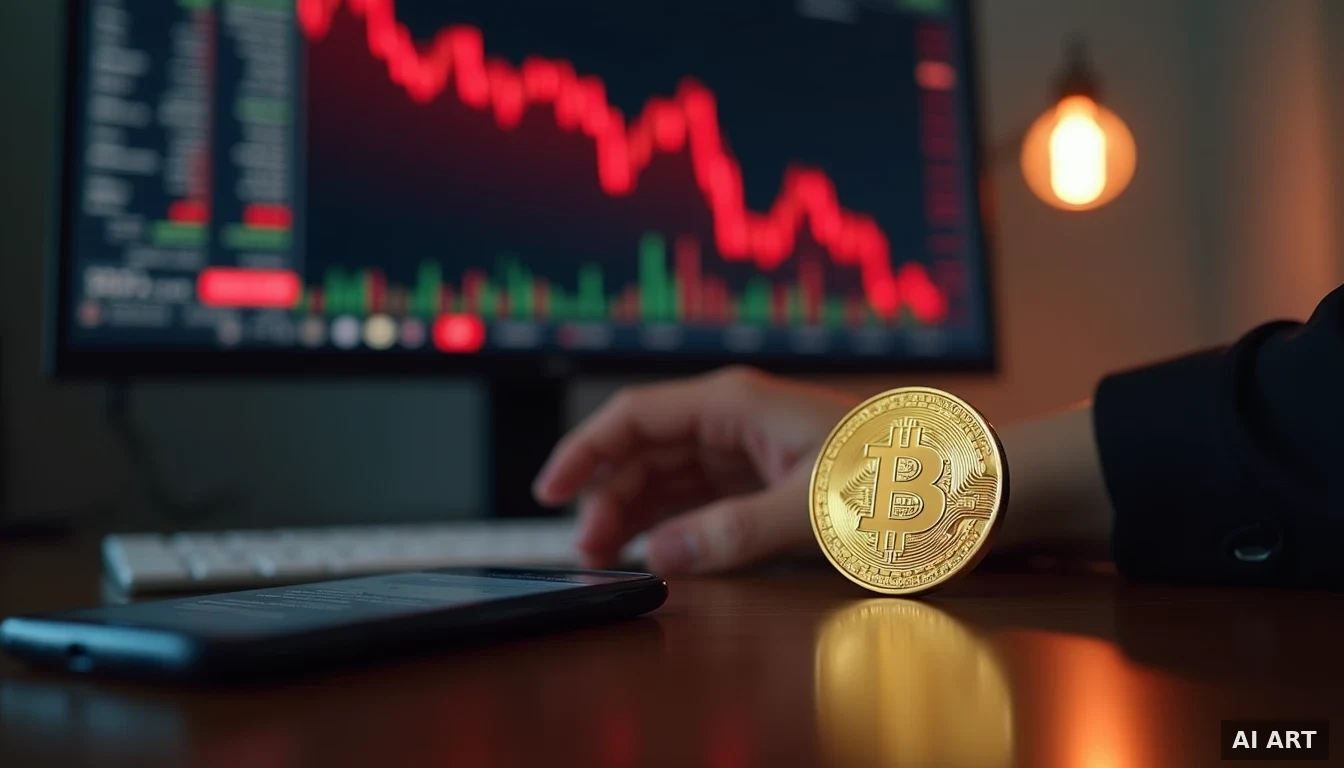
Bitcoin Slides Below $60,000 to 21-Month Low as ETF Outflows Mount
Multi-perspective analysis. Each perspective deliberately argues one viewpoint; none represents the editorial position of qalarc.
Bitcoin, which briefly touched roughly $65,034 on the morning of June 22, has since fallen sharply, tumbling below $60,000 and hitting a multi-year low near $58,000 on June 25 before bouncing to about $59,770 on June 26 — its lowest level since September 2024. The decline coincided with record investor withdrawals from spot bitcoin ETFs and an 'Extreme Fear' reading on widely watched sentiment gauges, even as some market participants insist the asset's historical cycle pattern points to an eventual recovery.
What the terms mean (5)
- Spot Bitcoin ETF — An exchange-traded fund that holds actual bitcoin and trades on traditional stock exchanges, letting investors gain price exposure without holding the coin directly; large inflows or outflows can move the market.
- CLARITY Act — Proposed U.S. legislation intended to define how cryptocurrencies are regulated and which agencies oversee them, including rules on how crypto firms can operate.
- Four-year cycle — A theory among crypto traders that Bitcoin's price moves in roughly four-year boom-and-bust cycles tied to its 'halving' events that cut new supply.
- Fear & Greed Index — A sentiment gauge scoring market mood from 0 ('Extreme Fear') to 100 ('Extreme Greed') based on volatility, volume and other inputs.
- Short squeeze — A rapid price rise that forces traders betting against an asset to buy it back to cover their positions, accelerating the move upward.
The facts (8)
- On June 22, 2026, Bitcoin traded around $65,034 at 9 a.m. ET, according to price tracking by Fortune. [1]
- By June 23-24, Bitcoin had slipped to roughly $62,200-$62,650. [2]
- On June 25, Bitcoin opened near $60,983 and reportedly fell to a multi-year low around $58,000, with some analysts flagging a potential short-squeeze setup. [3][6]
- On June 26, Bitcoin bounced from ~$58,000 to about $59,770 — its lowest level since September 2024, a roughly 21-month low — though derivatives data signaled possible further declines. [4]
- Investors pulled approximately $651 million from bitcoin ETFs during the week of June 25, described as record outflows. [5]
- Some online commentators argue Bitcoin 'historically recovers after 75% drawdowns' and will repeat its prior cycle pattern; others counter that 'too many people know about the four-year cycle for it to happen again,' invoking an 'observer effect.'
- Banking figures including JPMorgan's Jamie Dimon and the American Banking Association have voiced opposition to parts of the CLARITY Act over provisions allowing crypto firms to operate like banks. [8]
- Prediction markets and forecasters are actively debating where Bitcoin lands before 2027, with sentiment indices showing 'Extreme Fear.' [7]
Context & background
Bitcoin had traded well above $100,000 roughly a year earlier, and current reporting notes it sits tens of thousands of dollars below its level of twelve months ago — meaning the 2026 story is one of a major decline rather than a fresh climb. The recent slide came amid broad risk-off sentiment and heavy spot-ETF redemptions, with the Fear & Greed Index registering 'Extreme Fear' (a score around 13) in late June. [3][5] In Washington, the CLARITY Act — legislation aimed at clarifying U.S. crypto market structure — was approaching a Senate vote, drawing opposition from established banking interests who object to crypto firms being allowed to function like banks. [8] Against this backdrop, market participants remain split between those treating the drop as a buying opportunity consistent with past cycles and those warning of a deeper downtrend.
Still unresolved
- Whether the June 26 bounce from ~$58,000 marks a durable bottom or a temporary reprieve before further declines, as some derivatives signals suggest. [4]
- How the CLARITY Act vote and banking-sector opposition will affect crypto market structure and sentiment. [8]
- Whether sustained ETF outflows will continue to pressure prices or reverse. [5]
The same story, argued three ways. Pick an angle — the facts above stay the same.
🧭 Cui bono — who benefits?
Beneficiaries
- MicroStrategy and corporate Bitcoin treasury holders — Unrealized gains appreciation; reduced distance to liquidation thresholds; restored credibility for 'Bitcoin treasury strategy'
via Price recovery from ~$15k lows to $65k moves MSTR's 205k+ BTC holdings deeper into profit, lowers NAV breakeven, and validates the leveraged accumulation thesis to equity investors and potential corporate imitators - Spot Bitcoin ETF issuers (BlackRock, Fidelity, et al.) — Inflows resume; management fee revenue grows on larger AUM base
via Price momentum above psychological resistance attracts retail and institutional allocators who prefer regulated wrapper over direct custody; each billion in net inflows generates ~8-12 basis points annually in perpetual fees - Exchanges and derivatives platforms (CME, Coinbase, Binance) — Trading volume surge; liquidation cascades generate fee revenue; funding rate spreads widen
via Volatility around key price levels ($65k, potential $100k targets) triggers position closures, re-entries, and hedging activity; each percent of daily volume yields transaction fees, and liquidations force market orders at unfavorable prices - Long-biased crypto influencers and 'Bitcoin standard' advocates — Audience growth; sponsorship/affiliate revenue; social capital restoration after bear market credibility damage
via Price recovery validates multi-year 'HODL' narrative and cycle theory, driving traffic to content, courses, and affiliate exchange links; cada new all-time-high generates viral engagement and conference speaking slots
Who loses
- Leveraged short holders (per prior research: 40x short positions face liquidation as price rises, forcing loss crystallization and potential margin calls)
- Exit-liquidity seekers waiting for $150k (per prior coordinated-exit proposal: if rally stalls below that target, participants miss planned extraction window)
- Bear-case analysts and short-biased funds whose reputations and P&L depend on sustained downturn
- Alternative 'Ethereum-as-better-bet' proponents, as Bitcoin dominance reclaims narrative mindshare
Rivalry & conflicts of interest
- Short sellers and leveraged bears harmed → Long-biased whales and corporate accumulators (MSTR, etc.) gains
conflict of interest: Exchange platforms profit from both sides but have structural interest in volatility and liquidations regardless of direction; no known direct stake, but business model favors large position holders who generate ongoing trading fees over one-time short speculators - Altcoin ecosystems competing for 'digital gold' narrative harmed → Bitcoin maximalist coalitions and BTC-only investment vehicles gains
conflict of interest: Spot ETF issuers currently hold only Bitcoin products (BlackRock iShares, Fidelity Wise Origin); Ethereum ETF launch delayed, creating first-mover liquidity moat and institutional default to BTC allocation
Ramifications (follow the chain)
- Corporate treasury adoption accelerates -> more CEOs justify BTC buys using MSTR playbook -> equity analysts forced to model Bitcoin exposure as legitimate treasury diversification -> accounting rule pressure mounts for mark-to-market treatment -> further legitimizes volatile asset on balance sheets
- Retail FOMO at $65k+ -> late entrants buy at local tops -> subsequent consolidation or drawdown creates new cohort of underwater holders -> 'diamond hands' narrative required to prevent capitulation selling -> influencer ecosystem monetizes emotional support content and 'zoom out' copium
- ETF assets under management grow -> issuers custody larger BTC positions -> centralized holdings concentration increases (already >800k BTC in known ETF wallets) -> 'not your keys' criticism intensifies but remains ineffective against convenience premium -> custodians (Coinbase Custody, etc.) become systemically important, potential regulatory capture targets
- Momentum toward $100k psychological target -> media cycle amplifies -> new regulatory scrutiny as retail participation spikes -> potential for restrictive rules timed to 'protect investors' at cycle peak -> règulatory capture benefits incumbent financial players who can afford compliance infrastructure
intentional reading MicroStrategy and other corporate accumulators are actively managing narrative and timing buys to trigger momentum above key resistance levels, knowing that ETF flows are now mechanical followers of price action. By maintaining accumulation announcements during price strength (205k BTC purchase timed near this rally), MSTR creates reflexive loop: buy announcement -> price rise -> ETF inflows -> further price rise -> validates next leveraged buy. Exchanges benefit from orchestrating this volatility through strategic liquidation threshold placement and funding rate manipulation. The '$1M Bitcoin' countdown memes and cycle-pattern rhetoric are useful narrative infrastructure to keep retail committed through inevitable drawdowns, ensuring exit liquidity for sophisticated players planning extraction windows (per the $150k coordinated-exit discussion). BlackRock's spot ETF launch timing—after maximum regulatory delay—allowed Wall Street to accumulate positioning before offering retail access, classic pump-after-position pattern.
structural reading No coordination required: ETF approval created mechanical bid (flows chase performance), which rewards early corporate accumulators like MSTR whose cost basis is now deeply profitable. Exchanges profit from volatility in either direction, so have no directional bias but benefit from large moves that trigger liquidations and re-positioning. Influencers gain audience during price rises regardless of intent, creating organic bullish content amplification. Cycle theory becomes self-fulfilling as enough participants pattern-match to previous drawdown/recovery sequences and position accordingly, generating the very momentum the theory predicts. Retail enters late because mainstream media coverage follows price (not vice versa), ensuring natural exit liquidity for earlier entrants. Regulatory attention follows retail participation, creating predictable policy risk at cycle peaks—but incumbents survive regulatory tightening better than new entrants, so each cycle consolidates market structure around established players even as price volatility continues.
📊 Trading signals — winners & losers
Tradeable instruments most exposed to this story, inferred from the analysis above. Not financial advice — informational only, generated by AI from forum discussion and may be wrong.
📈 Likely winners
- ▲ BTCcryptoBitcoin$63,9487d +0.6%✓ +2.9% since callDirect price appreciation to $65k; narrative momentum restored
- ▲ MSTRstockMicroStrategy$98.067d +3.4%✓ +3.6% since callLarge Bitcoin treasury gains value; reduced liquidation risk
- ▲ COINstockCoinbase$150.297d +2.6%✗ -5.7% since callTrading volume surge; custody fees on rising asset base
- ▲ IBITETFiShares Bitcoin Trust$36.227d +0.2%✓ +2.8% since callSpot ETF inflows resume; management fees on larger AUM
- ▲ MARAstockMarathon Digital$9.717d -17.3%✗ -20.6% since callBitcoin miner; existing holdings appreciate with price recovery
📉 Likely losers
- ▼ ETHcryptoEthereum$1,8787d +0.9%✗ +7.9% since callBitcoin dominance narrative erodes 'Ethereum-as-better-bet' positioning
📈 Call performance — day by day
| date | price | vs entry |
|---|---|---|
| 2026-07-29 | $63,961 | +2.9% |
| 2026-07-30 | $64,213 | +3.3% |
| 2026-07-31 | $64,329 | +3.5% |
| 2026-08-01 | $63,017 | +1.4% |
| 2026-08-02 | $63,363 | +1.9% |
| 2026-08-03 | $63,118 | +1.5% |
| 2026-08-04 | $63,817 | +2.7% |
| 2026-08-05 | $64,396 | +3.6% |
| 2026-08-06 | $64,487 | +3.7% |
| 2026-08-07 | $64,280 | +3.4% |
| 2026-08-08 | $64,920 | +4.4% |
| 2026-08-09 | $64,799 | +4.2% |
| 2026-08-10 | $64,946 | +4.5% |
| 2026-08-11 | $63,994 | +2.9% |
showing last 14 of 22 days
| date | price | vs entry |
|---|---|---|
| 2026-07-29 | $96.16 | +1.6% |
| 2026-07-30 | $93.33 | -1.4% |
| 2026-07-31 | $97.74 | +3.3% |
| 2026-08-01 | $93.28 | -1.4% |
| 2026-08-02 | $93.28 | -1.4% |
| 2026-08-03 | $93.28 | -1.4% |
| 2026-08-04 | $94.86 | +0.2% |
| 2026-08-05 | $97.65 | +3.2% |
| 2026-08-06 | $98.37 | +3.9% |
| 2026-08-07 | $96.85 | +2.3% |
| 2026-08-08 | $100.01 | +5.7% |
| 2026-08-09 | $100.01 | +5.7% |
| 2026-08-10 | $100.01 | +5.7% |
| 2026-08-11 | $97.33 | +2.8% |
showing last 14 of 22 days
| date | price | vs entry |
|---|---|---|
| 2026-07-29 | $167.90 | +5.4% |
| 2026-07-30 | $160.09 | +0.5% |
| 2026-07-31 | $163.58 | +2.6% |
| 2026-08-01 | $146.26 | -8.2% |
| 2026-08-02 | $146.26 | -8.2% |
| 2026-08-03 | $146.26 | -8.2% |
| 2026-08-04 | $146.50 | -8.1% |
| 2026-08-05 | $150.73 | -5.4% |
| 2026-08-06 | $149.89 | -5.9% |
| 2026-08-07 | $145.41 | -8.8% |
| 2026-08-08 | $153.60 | -3.6% |
| 2026-08-09 | $153.60 | -3.6% |
| 2026-08-10 | $153.60 | -3.6% |
| 2026-08-11 | $148.68 | -6.7% |
showing last 14 of 22 days
| date | price | vs entry |
|---|---|---|
| 2026-07-29 | $36.14 | +2.6% |
| 2026-07-30 | $36.00 | +2.2% |
| 2026-07-31 | $36.70 | +4.2% |
| 2026-08-01 | $35.64 | +1.2% |
| 2026-08-02 | $35.64 | +1.2% |
| 2026-08-03 | $35.64 | +1.2% |
| 2026-08-04 | $36.16 | +2.6% |
| 2026-08-05 | $36.39 | +3.3% |
| 2026-08-06 | $36.74 | +4.3% |
| 2026-08-07 | $36.49 | +3.6% |
| 2026-08-08 | $36.80 | +4.5% |
| 2026-08-09 | $36.80 | +4.5% |
| 2026-08-10 | $36.80 | +4.5% |
| 2026-08-11 | $36.23 | +2.8% |
showing last 14 of 22 days
| date | price | vs entry |
|---|---|---|
| 2026-07-29 | $11.38 | -7.0% |
| 2026-07-30 | $10.05 | -17.8% |
| 2026-07-31 | $11.82 | -3.4% |
| 2026-08-01 | $11.32 | -7.4% |
| 2026-08-02 | $11.32 | -7.4% |
| 2026-08-03 | $11.32 | -7.4% |
| 2026-08-04 | $11.75 | -3.9% |
| 2026-08-05 | $11.75 | -3.9% |
| 2026-08-06 | $11.24 | -8.1% |
| 2026-08-07 | $10.65 | -12.9% |
| 2026-08-08 | $10.09 | -17.5% |
| 2026-08-09 | $10.09 | -17.5% |
| 2026-08-10 | $10.09 | -17.5% |
| 2026-08-11 | $9.56 | -21.8% |
showing last 14 of 22 days
| date | price | vs entry |
|---|---|---|
| 2026-07-29 | $1,912 | +9.9% |
| 2026-07-30 | $1,912 | +9.9% |
| 2026-07-31 | $1,904 | +9.5% |
| 2026-08-01 | $1,866 | +7.2% |
| 2026-08-02 | $1,872 | +7.6% |
| 2026-08-03 | $1,866 | +7.2% |
| 2026-08-04 | $1,866 | +7.2% |
| 2026-08-05 | $1,874 | +7.7% |
| 2026-08-06 | $1,898 | +9.1% |
| 2026-08-07 | $1,900 | +9.2% |
| 2026-08-08 | $1,913 | +9.9% |
| 2026-08-09 | $1,915 | +10.1% |
| 2026-08-10 | $1,915 | +10.1% |
| 2026-08-11 | $1,877 | +7.9% |
showing last 14 of 22 days
📊 See how every call has performed — the full scoreboard & API →
From the threads
The posts that drew the most replies in the source discussion — shown as posted. Reactions ranged across the spectrum; these are the ones people actually engaged with. Each quote links to its archived source thread so you can verify it; quotes we couldn't tie to a source thread are marked source unverified.
Too many people know about the 4 year cycle for it to happen again. Look up the observer effect.
Continue the discussion
Add your own take — replies are kept on this article and can be upvoted.
🔗 Related Analysis
- Claim that $65K is Bitcoin's bottom shared: bitcoin
- User claims to have charted a market bottom shared: bitcoin
- Tech influencer liquidates Bitcoin holdings following market losses shared: bitcoin
- MicroStrategy Bitcoin holdings hit 845k BTC after major stack shared: bitcoin
References
- [1] Current price of Bitcoin for June 22, 2026 | Fortune
- [2] Current price of Bitcoin for June 24, 2026 | Fortune
- [3] ◑ Bitcoin plunges to new multi-year low of $58,000 but a short-squeeze setup emerges | CoinDesk
- [4] ◑ Bitcoin bounces from $58,000 as derivatives signal more pain — Crypto Markets Today | CoinDesk
- [5] ◎ Bitcoin ETFs see record investor flight as cryptocurrency hits new lows | CNBC
- [6] Bitcoin and ethereum prices today, June 25, 2026: Bitcoin tumbles further below $60,000 | Yahoo Finance
- [7] What price will Bitcoin hit before 2027? Trading Odds & Predictions | Polymarket
- [8] Bitcoin Holds Near $64K as CLARITY Act Vote Looms | Analytics Insight
◖ supportive · ◗ critical · ◎ neutral wire · ◑ partisan · ⚑ state outlet
▾ Discussion
Select any text in the article to comment on that passage.