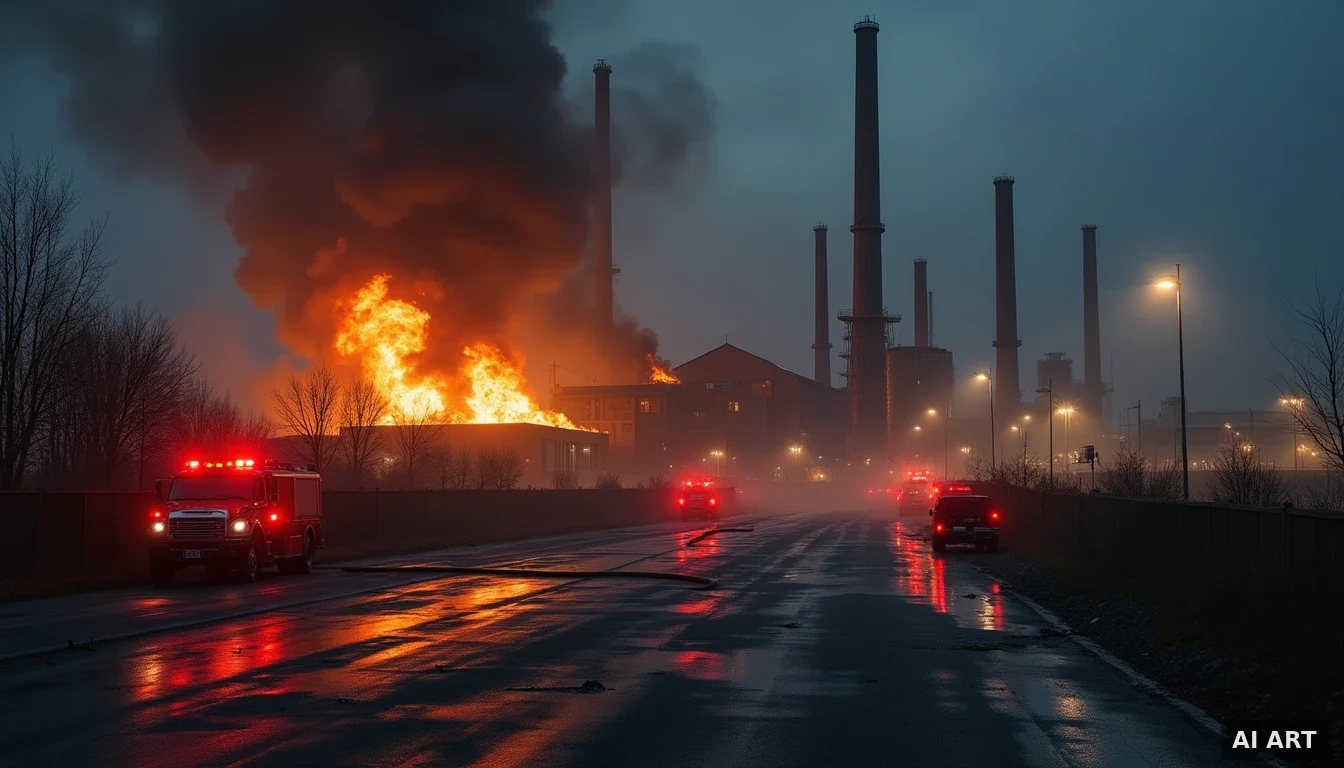
Ukraine Says 'Flamingo' Missiles Struck Volgograd Arms Plant as Occupied Crimea Declares State of Emergency
Multi-perspective analysis. Each perspective deliberately argues one viewpoint; none represents the editorial position of qalarc.
Ukrainian President Volodymyr Zelensky said that Ukrainian-made FP-5 'Flamingo' cruise missiles had 'successfully struck' the Titan-Barrikady defense plant in Volgograd, a producer of artillery systems and launchers for Russia's Iskander-M, Yars and Topol-M missiles. The strike, reported overnight into June 27, followed a June 26 declaration of a regional state of emergency by Russian-installed authorities in occupied Crimea, who cited power outages and fuel shortages amid intensified Ukrainian drone attacks.
What the terms mean (5)
- FP-5 'Flamingo' — A Ukrainian-developed long-range cruise missile designed for deep strikes inside Russian territory.
- Titan-Barrikady (FNPC) — A Volgograd defense enterprise that builds artillery systems and launchers for Russia's Iskander-M, Yars and Topol-M missiles.
- Iskander-M / Yars / Topol-M — Russian missile systems — Iskander-M is a short-range tactical ballistic system; Yars and Topol-M are intercontinental strategic missiles.
- Pantsir-S1 — A Russian short-range, mobile air-defense system combining surface-to-air missiles and anti-aircraft guns.
- Day 1,586 — A running daily count of Russia's full-scale invasion of Ukraine, measured from February 24, 2022.
The facts (8)
- On June 27, 2026, Zelensky said Ukrainian FP-5 'Flamingo' missiles 'successfully struck' the Titan-Barrikady (FNPC) defense enterprise in Volgograd, with a subsequent fire reported on the plant's premises [2].
- Titan-Barrikady manufactures artillery systems and launchers for the Iskander-M tactical missile system and the Yars and Topol-M strategic missile systems, and is under international sanctions [2][5].
- Volgograd Governor Andrey Bocharov confirmed that 'high-speed aerial targets' damaged production facilities in the Krasnooktyabrsky District and that 10 people were injured, but did not name the facility [1].
- Russian-installed authorities in occupied Crimea declared a regional state of emergency on June 26, 2026, citing economic problems amid intensified Ukrainian drone strikes [3][7].
- Occupation officials reported that roughly half the peninsula was without electricity as of June 23, alongside fuel sales restrictions [3].
- Ukraine's General Staff reported June 27 strikes on a Pantsir-S1 air-defense system in Feodosia and the Petropavlovsk vehicle ferry near Kerch in occupied Crimea [4].
- Russia's Defense Ministry said it shot down 175 Ukrainian drones over 10 regions and Crimea but did not acknowledge any missile strike on the Volgograd plant [2].
- The events fall on what daily trackers count as Day 1,586 of Russia's full-scale invasion, which began February 24, 2022.
Context & background
The FP-5 'Flamingo' is a long-range Ukrainian-developed cruise missile that Kyiv has publicized as part of an effort to build domestic deep-strike capability against targets far inside Russia [6]. Volgograd lies several hundred kilometers from the front, and a confirmed Flamingo strike there would mark a notable extension of Ukraine's reach against Russian defense-industrial infrastructure. Russian authorities described the incident in general terms — 'high-speed aerial targets' damaging 'production facilities' — without naming Titan-Barrikady, and have not independently confirmed a hit on the plant itself; the strike's full operational impact remains independently unverified [1][2]. The Crimea emergency declaration and the Volgograd strike are closely related as part of an intensified Ukrainian pressure campaign but are distinct events on different dates: the Crimea state of emergency was declared June 26, while the Volgograd strike occurred overnight into June 27 [3][7].
Still unresolved
- What was the actual operational damage to Titan-Barrikady, and how much production capacity (if any) was affected?
- Did the Volgograd strike use FP-5 'Flamingo' missiles as Zelensky stated, given Russia has not confirmed a missile hit on the plant?
- How long will the Crimea state of emergency last, and to what extent are the power and fuel shortages driven by Ukrainian strikes versus other economic factors?
The same story, argued three ways. Pick an angle — the facts above stay the same.
🧭 Cui bono — who benefits?
Beneficiaries
- Ukrainian military-industrial complex and Western defense contractors — Operational validation of long-range strike capabilities and continued justification for advanced weapons systems
via Successful strikes on Russian defense infrastructure (Volgograd plant) and critical infrastructure (Crimea emergency) demonstrate effectiveness of Ukrainian strike capabilities, creating demand signal for continued Western military aid packages and proving combat value of specific weapons platforms in real-world conditions - NATO intelligence apparatus and ISR (Intelligence, Surveillance, Reconnaissance) contractors — Real-time battlefield intelligence on Russian air defense positioning, supply vulnerabilities, and critical infrastructure resilience
via Day 1,586 of sustained conflict provides unprecedented continuous testing environment for Russian military capabilities, revealing defensive postures, supply chain chokepoints (railway bridges, refineries), and emergency response protocols that inform Western strategic planning and validate intelligence collection methods - Ukrainian political leadership (Zelensky administration) — Sustained international attention and leverage for continued aid despite Western 'coverage fatigue'
via High-profile strikes on Russian territory (Volgograd, Crimea) generate newsworthy developments that counter the noted decline in Western media coverage, maintaining Ukraine's position in policy prioritization and aid allocation discussions - Black Sea grain exporters and Turkish logistics intermediaries — Supply disruption in occupied Crimea creates commercial routing advantages and leverage
via Crimea state of emergency and continued infrastructure strikes force Russian military logistics through alternative (more expensive, less efficient) routes, while Ukrainian grain corridor arrangements through Turkey gain relative commercial value
Who loses
- Russian defense production capacity (Volgograd plant damage directly impacts munitions/weapons output)
- Civilian populations in Crimea (state of emergency implies resource scarcity, service disruption)
- Russian military logistics and resupply operations in southern theater (bridge strikes, infrastructure degradation)
- Western publics fatigued by prolonged conflict costs and inflation effects from sanctions/disruption
Rivalry & conflicts of interest
- Russian state defense industry (Rostec, UralVagonZavod, other domestic manufacturers) harmed → Western defense contractors (Lockheed Martin, Raytheon, BAE Systems, Rheinmetall) and emergent Ukrainian defense manufacturers gains
conflict of interest: NATO member states have direct financial stakes in Western defense contractors through pension funds, sovereign wealth holdings, and economic multiplier effects in domestic constituencies; prolonged conflict requiring continuous resupply directly benefits these holdings - Russian logistical control over Crimea and occupied territories harmed → Ukrainian territorial sovereignty claims and potential post-conflict reconstruction contracts (likely awarded to Western firms) gains
conflict of interest: Western governments and multilateral development banks positioned to finance reconstruction have institutional preference for territorial integrity framework that maximizes future lending/contracting opportunities in Ukrainian-controlled territory versus occupied zones
Ramifications (follow the chain)
- Crimea emergency + infrastructure degradation → Russian military forced into more expensive, circuitous supply routes → increased strain on already-stretched logistics → accelerated equipment/munitions depletion rates → either escalation to secure supply lines OR operational tempo reduction → in either case, extended timeline favors side with deeper industrial/financial reserves (NATO-backed Ukraine over sanctions-constrained Russia)
- Successful deep strikes on Russian defense plants → demonstration effect for other contested territories globally (Taiwan, Baltic states) → increased demand for long-range strike capabilities → validation of 'standoff warfare' doctrine → shifts defense procurement toward missiles/drones versus traditional armor/infantry → benefits precision-strike manufacturers, marginalizes conventional heavy-equipment producers
- Day 1,586 normalization of sustained conflict → Western media fatigue documented → public attention becomes scarce resource → Ukrainian strategy must produce increasingly dramatic results (deeper strikes, higher-value targets) to maintain aid flow → escalation ladder logic where tactical necessity drives strategic risk-taking → potential for spillover incidents increases as target set expands
- Volgograd strike specifically (interior Russia, defense-industrial target) → demonstrates Ukrainian capability to reach beyond contested border regions → Russian domestic population now shares direct risk → increases political pressure on Russian leadership either to escalate (mobilization, weapon types) or negotiate → but Russian regime survival tied to avoiding perception of defeat → creates conditions for frozen conflict with episodic escalation
intentional reading NATO intelligence services and Ukrainian command are deliberately executing a strategy of high-visibility strikes on Russian interior targets (Volgograd, Moscow refinery, Crimea) timed to coincide with declining Western media coverage and upcoming appropriations/aid cycles. The mechanism: dramatic strikes generate headlines that counter 'fatigue', validating continued aid packages; simultaneously, strikes on defense production specifically (Volgograd plant) create observable degradation in Russian capabilities that Western intelligence can brief to legislators as proof-of-concept for aid effectiveness. The rival-dynamic reading: this directly benefits Western defense contractors (who supply the strike systems) at the expense of Russian defense industry, while Western states with equity stakes in those contractors have structural incentive to see conflict continuation at intensity levels that require continuous resupply but avoid direct NATO-Russia escalation. The targeting prioritization (defense plants, refineries, bridges vs. purely military targets) suggests a dual-use strategy: military degradation AND economic signaling to maintain Western commitment.
structural reading No conspiracy required: Ukraine faces existential threat and rationally strikes highest-value targets accessible with available systems; Western defense industry benefits automatically from any prolonged conflict requiring resupply regardless of specific targeting choices; Russian infrastructure vulnerabilities (Crimea supply dependence, geographically dispersed defense industry) create natural target set; media coverage follows attention economy laws (fatigue is predictable, dramatic strikes temporarily reverse it); all parties optimize within their constraints. The rival dynamic emerges structurally: successful Ukrainian strikes degrade Russian defense output, creating relative advantage for Western defense manufacturers in global arms market reputation (their systems visibly outperform Russian equivalents), requiring no coordination beyond normal military-aid relationships. Western states benefit from demonstrated weakness of primary geopolitical rival while avoiding direct confrontation costs; this alignment of interests sustains support even as public enthusiasm wanes. The Crimea emergency specifically: infrastructure there was always vulnerable due to geographic isolation, Ukrainian strikes simply exploit pre-existing structural weakness, Russian emergency response is reactive rather than engineered.
📊 Trading signals — winners & losers
Tradeable instruments most exposed to this story, inferred from the analysis above. Not financial advice — informational only, generated by AI from forum discussion and may be wrong.
📈 Likely winners
- ▲ LMTstockLockheed Martin$597.777d +2.0%✓ +18.1% since callLong-range strike validation drives demand for advanced weapons systems
- ▲ NOCstockNorthrop Grumman$575.697d +5.0%✓ +12.2% since callISR and drone capabilities directly relevant to strikes
- ▲ RTXstockRTX Corporation$223.867d +3.3%✓ +13.8% since callAir defense and precision munitions beneficiary from continued conflict
- ▲ ZWcommodityWheat Futures$640.007d -0.4%✗ -4.3% since callBlack Sea disruption and Crimea emergency impacts grain routes
📉 Likely losers
- ▼ CLcommodityCrude Oil$83.767d +11.4%✗ +12.9% since callRussian defensive posture signals weakened production/export capacity near-term
- ▼ NGcommodityNatural Gas$2.767d +2.9%✓ -3.9% since callCrimea infrastructure damage and emergency threatens regional energy flows
- ▼ IEVETFEuropean Consumer Stocks$75.677d +1.4%✗ +4.4% since callProlonged conflict sustains inflationary pressures and consumer spending drag
📈 Call performance — day by day
| date | price | vs entry |
|---|---|---|
| 2026-07-30 | $569.20 | +12.5% |
| 2026-07-31 | $574.11 | +13.5% |
| 2026-08-01 | $582.74 | +15.2% |
| 2026-08-02 | $582.74 | +15.2% |
| 2026-08-03 | $582.74 | +15.2% |
| 2026-08-04 | $586.29 | +15.9% |
| 2026-08-05 | $589.33 | +16.5% |
| 2026-08-06 | $577.60 | +14.2% |
| 2026-08-07 | $582.85 | +15.2% |
| 2026-08-08 | $587.95 | +16.2% |
| 2026-08-09 | $587.95 | +16.2% |
| 2026-08-10 | $587.95 | +16.2% |
| 2026-08-11 | $603.16 | +19.2% |
| 2026-08-12 | $597.77 | +18.1% |
showing last 14 of 23 days
| date | price | vs entry |
|---|---|---|
| 2026-07-30 | $535.05 | +4.3% |
| 2026-07-31 | $534.85 | +4.3% |
| 2026-08-01 | $542.48 | +5.7% |
| 2026-08-02 | $542.48 | +5.7% |
| 2026-08-03 | $542.48 | +5.7% |
| 2026-08-04 | $548.47 | +6.9% |
| 2026-08-05 | $551.55 | +7.5% |
| 2026-08-06 | $557.47 | +8.7% |
| 2026-08-07 | $567.74 | +10.7% |
| 2026-08-08 | $571.58 | +11.4% |
| 2026-08-09 | $571.58 | +11.4% |
| 2026-08-10 | $571.58 | +11.4% |
| 2026-08-11 | $577.89 | +12.6% |
| 2026-08-12 | $575.69 | +12.2% |
showing last 14 of 23 days
| date | price | vs entry |
|---|---|---|
| 2026-07-30 | $215.25 | +9.4% |
| 2026-07-31 | $214.38 | +8.9% |
| 2026-08-01 | $215.22 | +9.4% |
| 2026-08-02 | $215.22 | +9.4% |
| 2026-08-03 | $215.22 | +9.4% |
| 2026-08-04 | $216.65 | +10.1% |
| 2026-08-05 | $217.93 | +10.7% |
| 2026-08-06 | $222.31 | +13.0% |
| 2026-08-07 | $223.25 | +13.5% |
| 2026-08-08 | $223.03 | +13.3% |
| 2026-08-09 | $223.03 | +13.3% |
| 2026-08-10 | $223.03 | +13.3% |
| 2026-08-11 | $224.12 | +13.9% |
| 2026-08-12 | $223.86 | +13.8% |
showing last 14 of 23 days
| date | price | vs entry |
|---|---|---|
| 2026-07-30 | $663.75 | -0.7% |
| 2026-07-31 | $663.50 | -0.7% |
| 2026-08-01 | $638.00 | -4.6% |
| 2026-08-02 | $639.25 | -4.4% |
| 2026-08-03 | $639.25 | -4.4% |
| 2026-08-04 | $651.50 | -2.5% |
| 2026-08-05 | $634.00 | -5.2% |
| 2026-08-06 | $644.00 | -3.7% |
| 2026-08-07 | $630.50 | -5.7% |
| 2026-08-08 | $638.25 | -4.5% |
| 2026-08-09 | $639.75 | -4.3% |
| 2026-08-10 | $652.00 | -2.5% |
| 2026-08-11 | $641.50 | -4.0% |
| 2026-08-12 | $630.50 | -5.7% |
showing last 14 of 23 days
| date | price | vs entry |
|---|---|---|
| 2026-07-30 | $83.50 | +12.5% |
| 2026-07-31 | $84.09 | +13.3% |
| 2026-08-01 | $86.80 | +17.0% |
| 2026-08-02 | $84.67 | +14.1% |
| 2026-08-03 | $84.67 | +14.1% |
| 2026-08-04 | $79.88 | +7.7% |
| 2026-08-05 | $74.88 | +0.9% |
| 2026-08-06 | $74.98 | +1.1% |
| 2026-08-07 | $78.07 | +5.2% |
| 2026-08-08 | $77.08 | +3.9% |
| 2026-08-09 | $78.18 | +5.4% |
| 2026-08-10 | $78.73 | +6.1% |
| 2026-08-11 | $82.21 | +10.8% |
| 2026-08-12 | $83.40 | +12.4% |
showing last 14 of 23 days
| date | price | vs entry |
|---|---|---|
| 2026-07-30 | $2.73 | -5.2% |
| 2026-07-31 | $2.76 | -3.8% |
| 2026-08-01 | $2.77 | -3.6% |
| 2026-08-02 | $2.75 | -4.4% |
| 2026-08-03 | $2.77 | -3.6% |
| 2026-08-04 | $2.77 | -3.7% |
| 2026-08-05 | $2.69 | -6.5% |
| 2026-08-06 | $2.67 | -6.9% |
| 2026-08-07 | $2.63 | -8.3% |
| 2026-08-08 | $2.67 | -7.0% |
| 2026-08-09 | $2.66 | -7.3% |
| 2026-08-10 | $2.72 | -5.3% |
| 2026-08-11 | $2.77 | -3.5% |
| 2026-08-12 | $2.76 | -3.9% |
showing last 14 of 23 days
| date | price | vs entry |
|---|---|---|
| 2026-07-30 | $72.91 | +0.6% |
| 2026-07-31 | $74.62 | +3.0% |
| 2026-08-01 | $74.29 | +2.5% |
| 2026-08-02 | $74.29 | +2.5% |
| 2026-08-03 | $74.29 | +2.5% |
| 2026-08-04 | $74.61 | +3.0% |
| 2026-08-05 | $75.34 | +4.0% |
| 2026-08-06 | $75.28 | +3.9% |
| 2026-08-07 | $75.23 | +3.8% |
| 2026-08-08 | $75.81 | +4.6% |
| 2026-08-09 | $75.81 | +4.6% |
| 2026-08-10 | $75.81 | +4.6% |
| 2026-08-11 | $75.61 | +4.3% |
| 2026-08-12 | $75.67 | +4.4% |
showing last 14 of 23 days
📊 See how every call has performed — the full scoreboard & API →
From the threads
The posts that drew the most replies in the source discussion — shown as posted. Reactions ranged across the spectrum; these are the ones people actually engaged with. Each quote links to its archived source thread so you can verify it; quotes we couldn't tie to a source thread are marked source unverified.
Previous: Day 1,586 – Daily assessment: understandingwar.org/analysis/russi a-ukraine/#research ▶Latest ▶Telegram rentry.org/telosint2023 t.me/ukr_pics ▶Intel t.me/DeepStateEN odin.tradoc.army.mil/WEG (equipment explorer) ukr.warspotting.net (visually confirmed losses) ▶Maps deepstatemap.live/en liveuamap.com/en ▶DISPOSABLE SOLDIER (diary of a RU mobik) TOURS 1-4: https://files.catbox.moe/19avc9.zip ▶russian confirmed KIA updated daily: https://hochuvernut.com/
Links shared in the discussion
Primary sources the threads posted — verify independently. These sometimes point to leads other coverage misses.
- hochuvernut.comshared 3×
- files.catbox.moeshared 3×
Continue the discussion
Add your own take — replies are kept on this article and can be upvoted.
🔗 Related Analysis
- Ukraine strikes Moscow refineries and Crimea railway bridge shared: crimea, russia, ukraine, understandingwar org
- Ukraine recaptures 600+ sq km territory; drones strike Chonhar Bridge twice shared: crimea, russia, ukraine
- Ukrainian forces strike Russian ammunition convoy and weapons storage in Crimea shared: crimea, russia, ukraine
- Russian offensive across all fronts and Western media coverage decline shared: russia, ukraine
- Russian military mishap in Ukraine conflict shared: russia, ukraine
- Ukraine strikes Voronezh semiconductor plant and Kerch Bridge; fuel rationing in Crimea shared: crimea, russia, ukraine
References
- [1] ◖ Russian Drone Barrage Kills 2 In Ukraine As Kyiv Says It Hit Russian Arms Plant — RFE/RL
- [2] ◖ Ukraine's Flamingo missiles 'successfully struck' key Russian military plant in Volgograd, Zelensky says — Kyiv Independent
- [3] ◖ Russian-installed authorities in occupied Crimea announce state of emergency amid intensified Ukrainian drone attacks — Kyiv Independent
- [4] ◖ Ukrainian Forces Strike Volgograd Defense Plant and Targets in Occupied Crimea — Kyiv Post
- [5] Defense plant in Volgograd hit by Flamingo missiles — UNN
- [6] ◎ FP-5 Flamingo — Wikipedia
- [7] ◑ Crimea placed under state of emergency as Ukraine steps up pressure on Putin — CNN
◖ supportive · ◗ critical · ◎ neutral wire · ◑ partisan · ⚑ state outlet
▾ Discussion
Select any text in the article to comment on that passage.