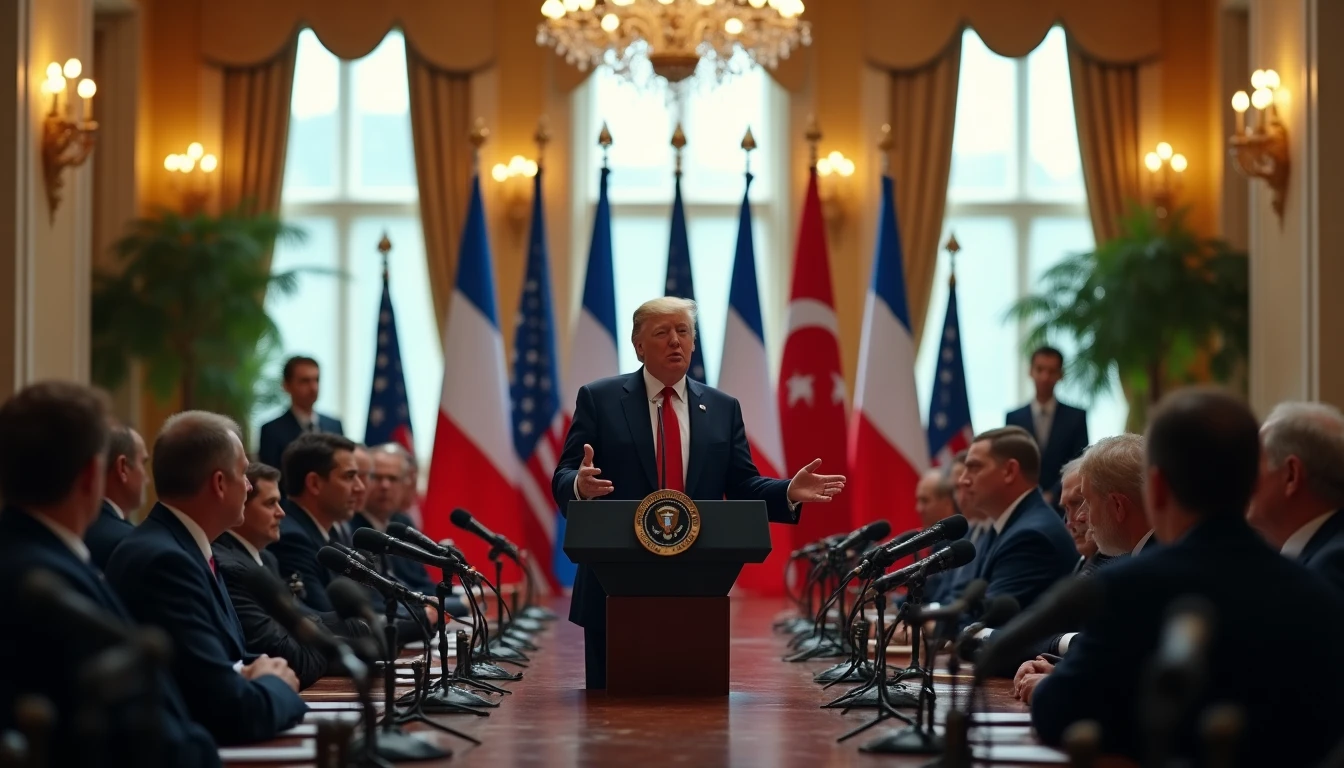
Trump Signs 14-Point Iran War MOU at Versailles; Terms Widely Read as US Concessions
Multi-perspective analysis. Each perspective deliberately argues one viewpoint; none represents the editorial position of qalarc.
President Donald Trump personally signed a 14-point memorandum of understanding to end the 2026 Iran war on or around June 17-19, 2026, at Versailles, capping a conflict that began February 28 with joint US-Israeli airstrikes on Iran. The MOU includes roughly $300 billion earmarked for Iranian reconstruction, sanctions relief, reopening of the Strait of Hormuz, and—per Trump's own remarks—Iran's right to enrich uranium and retain some ballistic missiles, drawing bipartisan criticism that it strengthened rather than defeated Iran.
What the terms mean (4)
- Memorandum of Understanding (MOU) — A preliminary written agreement laying out terms and intent between parties, often a precursor to a binding final treaty rather than a fully enforceable contract itself.
- Strait of Hormuz — A narrow waterway between Iran and Oman through which a large share of the world's seaborne oil passes; its closure can severely disrupt global energy markets.
- Operation Epic Fury — The US military operation name associated with the 2026 Iran war, under which the Congressional Research Service reported 13 US service personnel killed as of March 2026.
- Herbert Hoover reference — Hoover was the US president widely blamed for the onset of the Great Depression; Trump invoked the comparison to say he did not want to be blamed for economic catastrophe.
The facts (8)
- The 2026 Iran war opened on 28 February 2026 with joint US AND Israeli airstrikes on Iran that killed Supreme Leader Ali Khamenei and other senior officials [1][2].
- Iran retaliated with missile and drone strikes on Israel and US bases and closed the Strait of Hormuz, disrupting global trade [2].
- A two-week ceasefire was reached on 7-8 April 2026, mediated by Pakistan; subsequent Islamabad talks stalled and the US imposed a naval blockade [3][10].
- Mediators announced a US-Iran 14-point MOU on 14 June 2026; Trump signed it personally at Versailles around 17-19 June 2026 [5][9].
- The MOU includes ~$300 billion for Iranian reconstruction (Trump claiming the US itself won't fund it), sanctions relief, reopening the Strait of Hormuz, and—per Trump's June 17 remarks—Iran's right to enrich uranium and develop some ballistic missiles, with a final deal to be negotiated over 60 days [5][7][8].
- Trump defended the agreement as having AVOIDED 'economic catastrophe,' citing record stock market highs and falling oil prices, and said he did not want to be blamed like Herbert Hoover [9].
- Per the Congressional Research Service (as of 23 March 2026), 13 US service personnel were killed in Operation Epic Fury; Israel, France and GCC states reported additional deaths, and Iran reported 3,000+ fatalities [4].
- The deal drew bipartisan criticism—from figures including Cassidy, Cornyn, Wicker, Pelosi, Haley and Pence—that it represented US concessions to Iran, with some calling it an 'American surrender' [6][9].
Context & background
The conflict was fought by the United States and Israel as co-belligerents, not by the US alone, and Pakistan acted as the principal mediator [2][3]. After the opening strikes killed Iran's Supreme Leader and other leaders, Iran's closure of the Strait of Hormuz triggered a global trade and energy crisis that shaped the diplomatic timeline [2]. The April ceasefire's collapse and the ensuing naval blockade preceded the June MOU [3][10]. Several claims circulating online diverge sharply from the documented reporting: that Iran achieved a conventional military victory establishing it as 'the world's strongest nation,' that Trump conceded '$400B in assets' and agreed to reparations while predicting a US depression, and that attention is turning to targeting China militarily next. The documented record instead shows a negotiated MOU—broadly characterized as favorable to Iran—centered on ~$300 billion in reconstruction, sanctions relief and enrichment/missile provisions, with a final deal still to be negotiated [5][6][7][8]. The relevant China dimension in reporting concerns US efforts to end Iran's discounted oil sales to China, not military confrontation.
Still unresolved
- What the final deal—to be negotiated over the 60 days following the MOU—will actually contain on enrichment limits, missile caps and sanctions sequencing.
- Who will fund the ~$300 billion in Iranian reconstruction, given Trump's claim that the US will not.
- How Iran's post-Khamenei leadership structure has stabilized following the deaths of senior officials in the opening strikes.
The same story, argued three ways. Pick an angle — the facts above stay the same.
From the threads
The posts that drew the most replies in the source discussion — shown as posted. Reactions ranged across the spectrum; these are the ones people actually engaged with. Each quote links to its archived source thread so you can verify it; quotes we couldn't tie to a source thread are marked source unverified.
Trump’s press conference was INSANE: He confirmed that: • Iran gets $300B + $100B unfrozen • Iran has the RIGHT to ballistic missiles • The U.S. was running out of oil • A worldwide depression was coming I was predicting all of this from the first week including that REPARATIONS were coming and got a lot of hate for it. The sellout MAGA frauds are now going to change their entire life-philosophy and deeply held “principles” over night. Trump is on his knees. This was ALWAYS the ONLY way it was going to end. Even if he thinks he can start the war again. Iran will always win. It’s check mate. Al
Continue the discussion
Add your own take — replies are kept on this article and can be upvoted.
🔗 Related Analysis
- Khamenei describes Trump as honorable amid Iran-US relations shared: iran, trump, usa
- Iran war civilian casualty toll and infrastructure damage shared: iran, usa
- Iran military gains assertion shared: iran, trump
- Criticism of perceived ignorance about Iran among a demographic group shared: iran, trump
- Satirical post impersonating Iranian demanding US money shared: iran, usa
- Trump administration criticized for Iran war and $300 billion settlement shared: iran, trump
References
- [1] ◎ 2026 Iran war — Britannica
- [2] ◎ 2026 Iran war — Wikipedia
- [3] ◎ 2026 Iran war ceasefire — Wikipedia
- [4] ◎ Congressional Research Service report R48887 on the 2026 Iran conflict
- [5] ◎ Trump Iran deal MOU: nuclear, Hormuz terms — CNBC
- [6] ◑ Trump finally sealed his Iran deal. Now talks on the 'final' deal begin — NBC News
- [7] ◎ Trump defends Iran missile rights — The Hill
- [8] ◑ As deal takes force, Trump says 'it's okay' for Iran to have some ballistic missiles — Times of Israel
- [9] ◑ Trump personally signs Iran deal at Versailles — Fox News
- [10] Walking a Tightrope: Scenarios for Iran–US Confrontation — Al Jazeera Centre for Studies
◖ supportive · ◗ critical · ◎ neutral wire · ◑ partisan · ⚑ state outlet
▾ Discussion
Select any text in the article to comment on that passage.