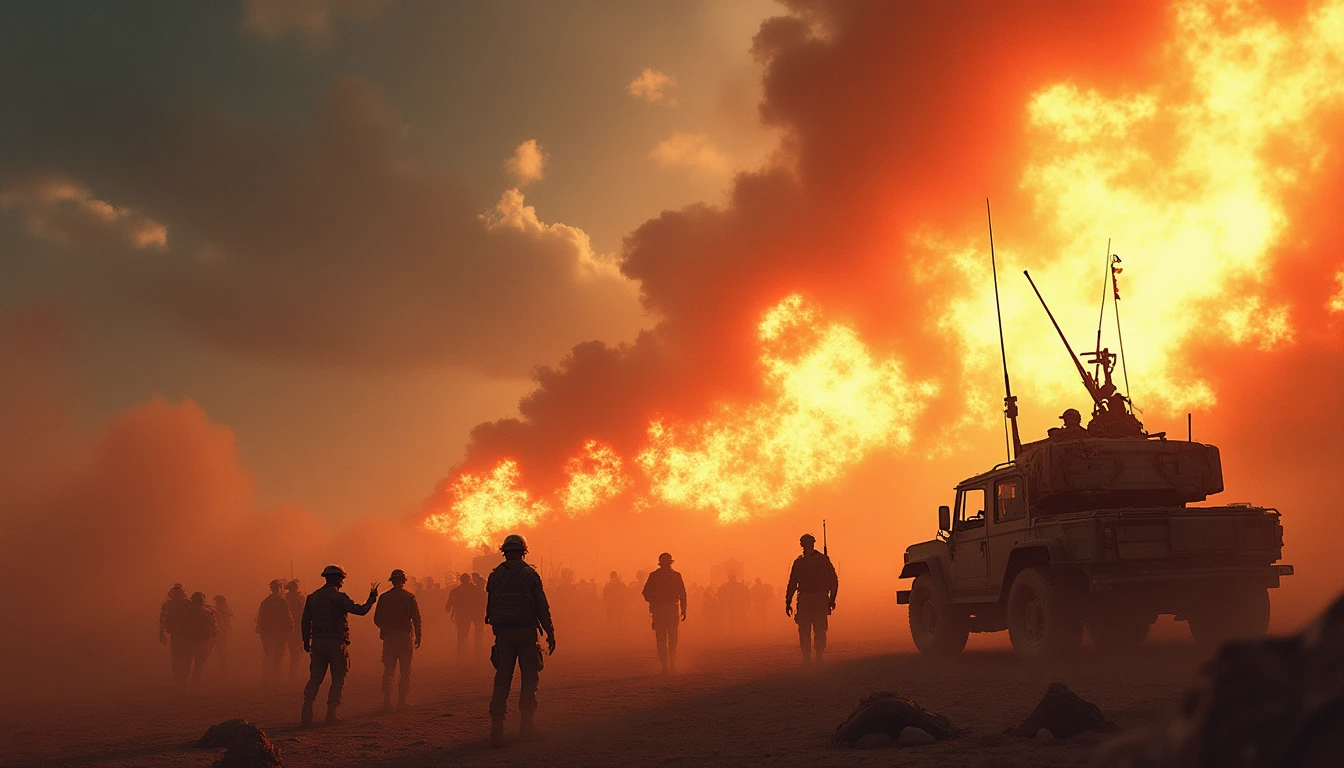
Iran's Military Campaign Against Israel and US Assessed as Catastrophic Failure as War Enters Uneasy Ceasefire
Multi-perspective analysis. Each perspective deliberately argues one viewpoint; none represents the editorial position of qalarc.
Iran's military confrontation with Israel and the United States — fought across the June 2025 Twelve-Day War and the far larger war that reignited on 28 February 2026 — has been widely assessed by analysts as a catastrophic defeat, with Iran's air defenses overwhelmed, its leadership decimated and Supreme Leader Ali Khamenei killed in an Israeli strike. As of mid-to-late June 2026, with a US-Iran memorandum of understanding in place, Iran says Washington committed on behalf of its partners to end the war on all fronts, including Lebanon, and warns it will treat Israeli violations as breaches that could reignite fighting.
What the terms mean (4)
- Twelve-Day War — The 13–24 June 2025 conflict in which Israel and the US struck Iran's air defenses and nuclear sites while Iran launched missiles and drones, ended by a ceasefire.
- Operation Epic Fury — The codename for the US-Israeli assault that reignited the war on 28 February 2026 with roughly 900 strikes in 12 hours.
- Memorandum of understanding (MoU) — The US-Iran agreement signed around 17 June 2026 to permanently end military operations 'on all fronts, including Lebanon,' whose full text has not been published.
- Strait of Hormuz — A strategically critical waterway through which much of the world's oil passes; Iran moved to close it during the conflict over Israeli strikes.
The facts (8)
- The Twelve-Day War (13–24 June 2025) saw Israel — joined by US strikes on Iran's Fordow and Natanz nuclear sites on 22 June — overwhelm Iran's air defenses; Iran fired an estimated 550–900 ballistic missiles and roughly 1,000 drones, mostly intercepted, killing about 28 civilians in Israel [1][11].
- Analysts at the Foreign Policy Research Institute characterized the June 2025 outcome as a 'humiliating military defeat' and transformative blow to the Islamic Republic [4].
- A ceasefire took effect 24 June 2025 ending the Twelve-Day War; fighting resumed 28 February 2026 with a US-Israeli assault dubbed 'Operation Epic Fury' of roughly 900 strikes in 12 hours [2][10].
- On 28 February 2026, Supreme Leader Ali Khamenei was killed in an Israeli strike on his compound, confirmed by Iranian state media on 1 March 2026, along with numerous senior commanders [2].
- HRANA documented 3,636 deaths in Iran as of 7 April 2026 (including 1,221 military); CSIS assessed Iran's conventional capabilities 'badly degraded' and its leadership 'decimated' [3][5].
- A US-Iran memorandum of understanding, signed around 17 June 2026, calls for permanent termination of military operations 'on all fronts, including Lebanon'; the deal's full text has not been publicly released [6][7].
- Iranian officials including Foreign Minister Abbas Araghchi and Deputy FM Takht-Ravanchi state the US committed on behalf of its partners to end the war, and that continued Israeli occupation or violations in Lebanon will be treated as MoU breaches activating Iran's response mechanisms [6][7].
- President Trump warned on 21 June 2026 that the US would 'hit Iran very hard again' over Hezbollah, while Iran's negotiator Qalibaf said its forces are ready to respond — a mutual war-threat dynamic tied to compliance [8].
Context & background
The current confrontation unfolded in two distinct phases rather than as a single campaign. The first was the Twelve-Day War of June 2025, ended by a ceasefire on 24 June 2025 [1][10]. The much larger 2026 Iran war began on 28 February 2026, when a US-Israeli assault killed Khamenei and large parts of Iran's military command [2]. Casualty figures remain disputed and likely undercounted, with Iran, Israel and the US each holding incentives to shape the narrative [3]. Iran also imposed real costs of its own, including closing the Strait of Hormuz over Israeli strikes [7]. The mid-2026 diplomatic track produced a US-Iran 'road map' and memorandum of understanding, the central sticking point of which is a clause requiring Israeli withdrawal from Lebanon [8][9]. Notably, real-world reporting shows it is the Israeli government, not abstract 'interests,' that has objected to the deal's Lebanon concessions, and the White House has been described as not fully acknowledging the cost to Israel [9].
Still unresolved
- What does the full, unreleased text of the US-Iran memorandum of understanding actually require, and how binding are its Lebanon provisions?
- What are the true casualty figures from the 2026 war, given disputed and undercounted tallies from all sides?
- Will Israeli operations in Lebanon, or US threats over Hezbollah, trigger a renewed phase of the conflict, and how would Iran respond given its degraded capabilities?
The same story, argued three ways. Pick an angle — the facts above stay the same.
🧭 Cui bono — who benefits?
Beneficiaries
- United States government and military-industrial complex — Comprehensive strategic victory establishing regional dominance, extraction of massive reparations, and justification for continued defense spending
via Military defeat of Iran eliminates primary regional adversary while $300B reparations transfer provides both fiscal windfall and ongoing financial leverage; MoU terms lock Iran into compliance framework enforceable by threat of resumed conflict - Israel — Neutralization of existential threat and regional military supremacy
via Iran's catastrophic losses (extreme casualties, loss of air superiority, naval blockade) eliminate primary strategic threat while US guarantees Israeli security through enforcement provisions making Washington responsible for agreement compliance - US defense contractors and military establishment — Validation of doctrine, weapons systems, and sustained budgets
via Demonstration of conventional military superiority justifies $80B+ operational expenditure and provides empirical case for continued procurement; Iran's defeat validates existing force structure against peer threats - Regional US allies (Saudi Arabia, UAE, Gulf states) — Removal of Iranian regional influence and threat
via Iran's military collapse and financial subordination eliminates Shia regional competitor, shifts balance of power decisively toward Sunni Gulf monarchies aligned with US interests
Who loses
- Iran (catastrophic military losses, financial subjugation, sovereignty constraints)
- Iranian military and IRGC leadership (professional and institutional decimation)
- Anti-Western resistance axis (Hezbollah, Syria, Yemen groups lose primary sponsor)
- Multipolarity advocates (outcome reinforces US unilateral military dominance)
Rivalry & conflicts of interest
- Iran harmed → Saudi Arabia and Gulf Cooperation Council states gains
conflict of interest: US has extensive defense treaties, arms sales relationships, and energy partnerships with Gulf monarchies; outcome shifts regional balance decisively in favor of established US client states - Iran harmed → Israel gains
conflict of interest: US political establishment maintains deep strategic alliance with Israel; outcome eliminates Israel's primary existential threat while MoU makes US guarantor of Israeli security against Iranian violations - China and Russia (Iran as strategic partner) harmed → United States gains
conflict of interest: Iran served as key node in China-Russia axis challenging US hegemony; Iranian defeat demonstrates risks of opposing US militarily and weakens alternative pole of power
Ramifications (follow the chain)
- Iran's defeat demonstrates prohibitive costs of conventional military confrontation with US -> other potential adversaries (China, Russia) recalibrate risk assessments -> increased emphasis on asymmetric capabilities (cyber, proxy warfare, economic coercion) rather than direct confrontation
- $300B reparations create structural dependency -> Iran's economy oriented toward debt service -> domestic political instability as resources diverted from public goods -> potential regime fragility -> US gains leverage for further concessions or faces destabilization risks
- US enforcement responsibility for Israeli compliance creates moral hazard -> Israel may take aggressive actions knowing US must prevent Iranian response to maintain agreement -> US becomes guarantor of Israeli freedom of action -> entanglement in future regional conflicts
- Demonstration of overwhelming US conventional superiority -> reassures allies but encourages adversaries to pursue unconventional deterrents -> acceleration of nuclear programs, cyber capabilities, and non-state proxy networks by states fearing similar fate
intentional reading US and Israeli military and intelligence establishments deliberately engineered confrontation with Iran at moment of maximum tactical advantage to achieve generational strategic reset in Middle East. The operation accomplished multiple synchronized objectives: (1) elimination of Iranian military capacity, (2) financial subordination through reparations extracting 3.75x operation costs, (3) creation of enforcement mechanism making future Iranian resistance prohibitively costly, (4) demonstration effect warning China/Russia/North Korea of conventional confrontation costs, (5) validation of defense expenditures and weapons systems justifying continued procurement. The MoU structure—making US responsible for Israeli compliance while threatening war for violations—was deliberately designed to maximize Israeli freedom of action while locking Iran into no-win scenario. Timing suggests coordination with broader geopolitical realignment: eliminate Iranian threat while US still possesses overwhelming conventional superiority before peer competitors close capability gaps.
structural reading Once military engagement began, regardless of initiation circumstances, institutional incentives aligned across multiple actors to pursue maximalist outcome. US military establishment had professional and budgetary incentives to demonstrate decisive victory justifying expenditures; Israeli security apparatus had existential incentive to permanently degrade Iranian threat; Gulf allies had regional power-balance incentives to support Iranian defeat; defense contractors had commercial incentives in proven systems. Iran's catastrophic losses created opportunity for reparations extraction that fiscal pressures made irresistible. MoU terms reflect standard victor-impose-terms dynamics: US assumes enforcement role because only party with leverage over both sides, while structure favoring Israeli security reflects relative alliance commitments. No conspiracy required—just alignment of institutional interests toward exploitation of military victory for maximum strategic and financial gain, with each actor pursuing logical self-interest within constraints.
📊 Trading signals — winners & losers
Tradeable instruments most exposed to this story, inferred from the analysis above. Not financial advice — informational only, generated by AI from forum discussion and may be wrong.
📈 Likely winners
- ▲ LMTstockLockheed Martin$582.747d +2.5%✓ +15.2% since callDefense contractor benefits from validated military systems, continued spending
- ▲ NOCstockNorthrop Grumman$542.487d +1.7%✓ +5.7% since callMilitary-industrial complex gains from regional conflict, budget justification
- ▲ RTXstockRaytheon Technologies$215.227d +2.9%✓ +9.4% since callWeapons systems validation drives demand from US, regional allies
- ▲ GDstockGeneral Dynamics$383.427d +0.4%✓ +2.4% since callDefense spending sustained by demonstrated regional military dominance
- ▲ CLcommodityCrude Oil$84.677d -5.2%✓ +14.1% since callIranian supply disruption risk, regional instability premium in pricing
📉 Likely losers
- ▼ XAUcommodityGold$4,1077d +1.0%✗ +0.9% since callSafe-haven demand falls as regional threat neutralized decisively
📈 Call performance — day by day
| date | price | vs entry |
|---|---|---|
| 2026-06-28 | $505.99 | +0.0% |
| 2026-07-21 | $505.99 | +0.0% |
| 2026-07-22 | $507.09 | +0.2% |
| 2026-07-23 | $514.36 | +1.7% |
| 2026-07-25 | $568.59 | +12.4% |
| 2026-07-26 | $582.60 | +15.1% |
| 2026-07-27 | $582.60 | +15.1% |
| 2026-07-28 | $580.00 | +14.6% |
| 2026-07-29 | $581.31 | +14.9% |
| 2026-07-30 | $569.20 | +12.5% |
| 2026-07-31 | $574.11 | +13.5% |
| 2026-08-01 | $582.74 | +15.2% |
| 2026-08-02 | $582.74 | +15.2% |
| date | price | vs entry |
|---|---|---|
| 2026-06-28 | $513.01 | +0.0% |
| 2026-07-21 | $513.01 | +0.0% |
| 2026-07-22 | $512.29 | -0.1% |
| 2026-07-23 | $525.28 | +2.4% |
| 2026-07-25 | $542.24 | +5.7% |
| 2026-07-26 | $542.24 | +5.7% |
| 2026-07-27 | $542.24 | +5.7% |
| 2026-07-28 | $547.58 | +6.7% |
| 2026-07-29 | $549.22 | +7.1% |
| 2026-07-30 | $535.05 | +4.3% |
| 2026-07-31 | $534.85 | +4.3% |
| 2026-08-01 | $542.48 | +5.7% |
| 2026-08-02 | $542.48 | +5.7% |
| date | price | vs entry |
|---|---|---|
| 2026-06-28 | $196.78 | +0.0% |
| 2026-07-21 | $196.78 | +0.0% |
| 2026-07-22 | $193.67 | -1.6% |
| 2026-07-23 | $194.88 | -1.0% |
| 2026-07-25 | $212.79 | +8.1% |
| 2026-07-26 | $212.79 | +8.1% |
| 2026-07-27 | $212.79 | +8.1% |
| 2026-07-28 | $218.42 | +11.0% |
| 2026-07-29 | $218.58 | +11.1% |
| 2026-07-30 | $215.25 | +9.4% |
| 2026-07-31 | $214.38 | +8.9% |
| 2026-08-01 | $215.22 | +9.4% |
| 2026-08-02 | $215.22 | +9.4% |
| date | price | vs entry |
|---|---|---|
| 2026-06-28 | $374.31 | +0.0% |
| 2026-07-21 | $370.60 | -1.0% |
| 2026-07-22 | $367.73 | -1.8% |
| 2026-07-23 | $373.16 | -0.3% |
| 2026-07-25 | $381.79 | +2.0% |
| 2026-07-26 | $386.75 | +3.3% |
| 2026-07-27 | $386.75 | +3.3% |
| 2026-07-28 | $389.14 | +4.0% |
| 2026-07-29 | $393.19 | +5.0% |
| 2026-07-30 | $380.96 | +1.8% |
| 2026-07-31 | $382.20 | +2.1% |
| 2026-08-01 | $383.42 | +2.4% |
| 2026-08-02 | $383.42 | +2.4% |
| date | price | vs entry |
|---|---|---|
| 2026-06-28 | $74.20 | +0.0% |
| 2026-07-21 | $83.71 | +12.8% |
| 2026-07-22 | $84.74 | +14.2% |
| 2026-07-23 | $87.80 | +18.3% |
| 2026-07-25 | $92.19 | +24.2% |
| 2026-07-26 | $89.31 | +20.4% |
| 2026-07-27 | $84.95 | +14.5% |
| 2026-07-28 | $81.41 | +9.7% |
| 2026-07-29 | $82.23 | +10.8% |
| 2026-07-30 | $83.50 | +12.5% |
| 2026-07-31 | $84.09 | +13.3% |
| 2026-08-01 | $86.80 | +17.0% |
| 2026-08-02 | $84.67 | +14.1% |
| date | price | vs entry |
|---|---|---|
| 2026-06-28 | $4,070 | +0.0% |
| 2026-07-21 | $4,070 | +0.0% |
| 2026-07-22 | $4,086 | +0.4% |
| 2026-07-23 | $4,119 | +1.2% |
| 2026-07-25 | $4,053 | -0.4% |
| 2026-07-26 | $4,071 | +0.0% |
| 2026-07-27 | $4,087 | +0.4% |
| 2026-07-28 | $4,075 | +0.1% |
| 2026-07-29 | $4,017 | -1.3% |
| 2026-07-30 | $4,135 | +1.6% |
| 2026-07-31 | $4,173 | +2.6% |
| 2026-08-01 | $4,099 | +0.7% |
| 2026-08-02 | $4,107 | +0.9% |
📊 See how every call has performed — the full scoreboard & API →
🔗 Related Analysis
- Trump administration criticized for Iran war and $300 billion settlement shared: iran, israel
- US releases official Memorandum of Understanding text on Iran agreement shared: iran, us
- Dispute over Iran-US war outcome and Iranian military capability shared: iran, israel
- Violent threat against Israel and Jewish people shared: iran, israel
- Satirical claim of US-Iran peace treaty shared: iran, israel
- Iran shoots down US helicopter; US escalation expected shared: iran, israel, us
References
- [1] ◎ Twelve-Day War - Wikipedia
- [2] ◎ 2026 Iran war - Wikipedia
- [3] ◎ Casualties of the 2026 Iran war - Wikipedia
- [4] Humiliation and Transformation: The Islamic Republic After the 12-Day War - FPRI
- [5] ◑ Who Is Winning the Iran War? - CSIS
- [6] ◎ Iran says the deal to end the war with the U.S. requires Israel to withdraw from Lebanon - PBS News
- [7] ◖ Iran says deal with U.S. requires Israeli forces to leave Lebanon - CBS News
- [8] ◎ U.S. and Iran agree to 'road map' for final deal, mediators say - NPR
- [9] ◑ The Iran Deal Comes at a Cost to Israel - Council on Foreign Relations
- [10] ◎ Twelve-Day War ceasefire - Wikipedia
- [11] ◎ 12-Day War - Britannica
◖ supportive · ◗ critical · ◎ neutral wire · ◑ partisan · ⚑ state outlet
▾ Discussion
Select any text in the article to comment on that passage.