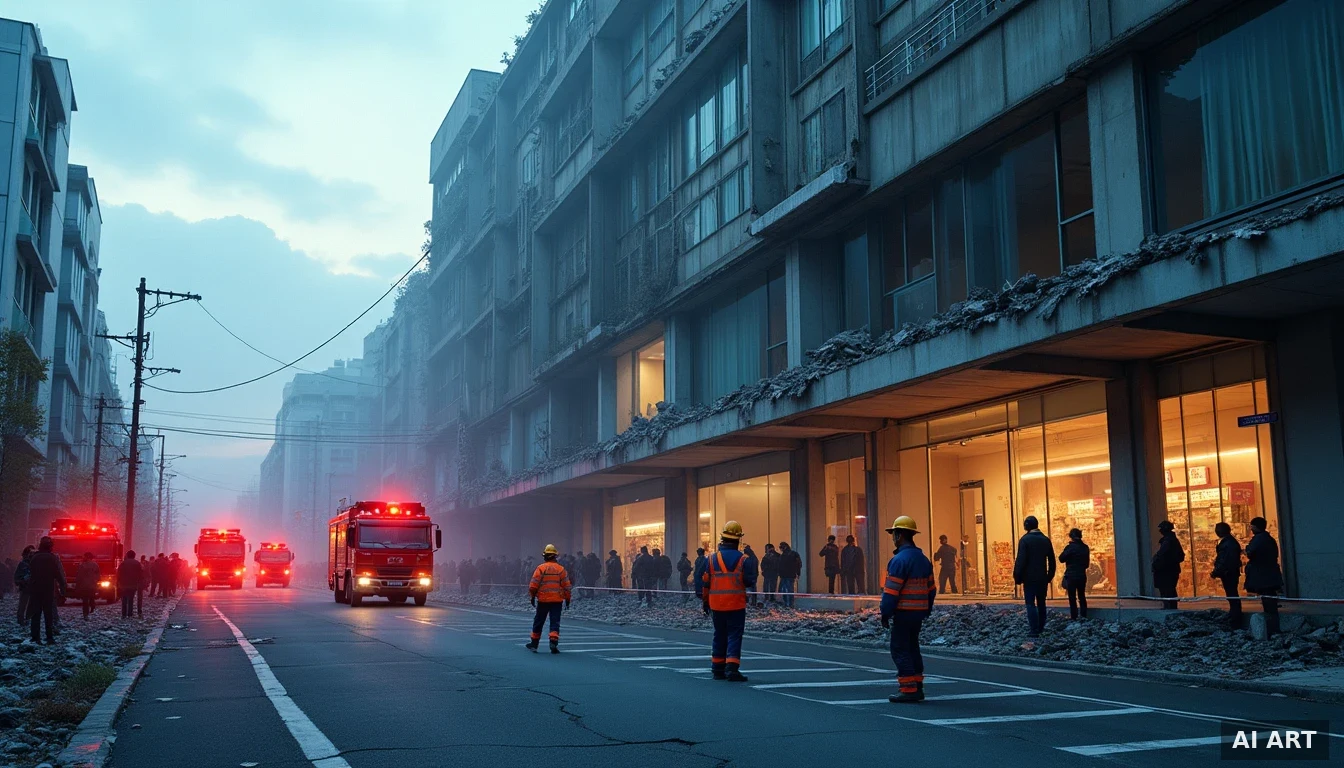
Magnitude 6.8 Earthquake Hits Kumamoto; Explosion Partially Collapses Aeon Mall, at Least 13 Dead
Multi-perspective analysis. Each perspective deliberately argues one viewpoint; none represents the editorial position of qalarc.
A powerful earthquake struck Kumamoto Prefecture on the Japanese island of Kyushu at 4:30pm JST on Tuesday, July 28, 2026, and roughly an hour later an explosion — attributed by local authorities to a probable gas leak from quake-damaged equipment — caused a partial collapse of the newly rebuilt Aeon Mall Kumamoto. By early Wednesday, Prime Minister Sanae Takaichi said at least 13 people had been confirmed dead across the disaster, with deaths reported at the mall itself.
What the terms mean (4)
- Shindo 7 — The maximum level on Japan's seismic intensity scale, which measures ground shaking at a location rather than the earthquake's overall energy; a shindo 7 indicates violent, potentially building-destroying shaking.
- Aeon Mall Kumamoto — A large shopping mall operated by Japanese retail group Aeon, rebuilt and reopened on June 13, 2026 after the original was destroyed in the 2016 Kumamoto earthquakes.
- Sanae Takaichi — Japan's prime minister at the time of the disaster, who announced the initial confirmed death toll.
- JMA / USGS — The Japan Meteorological Agency and the U.S. Geological Survey, two agencies that measure earthquakes; here they gave differing initial magnitudes (7.1 vs. a later 6.8).
The facts (8)
- The Japan Meteorological Agency initially measured the quake at magnitude 7.1; the U.S. Geological Survey later revised it to magnitude 6.8. It struck at 4:30pm JST (07:30 GMT) on July 28, 2026 [3][4].
- A rare shindo 7 — the maximum on Japan's seismic intensity scale — was observed in the towns of Hikawa and Uki, and around 300,000 residents were told to seek shelter [3].
- Roughly an hour after the quake, an explosion partially collapsed Aeon Mall Kumamoto; about 200 shoppers had been safely evacuated beforehand [2][5].
- NHK reported that 20 to 30 mall employees could not be contacted after the collapse; NBC News reported at least 50 injured and multiple people trapped [7].
- Local authorities and TV Asahi indicated the explosion may have been caused by a gas leak after gas equipment was damaged in the quake, with investigations ongoing [5].
- By early Wednesday, PM Sanae Takaichi said at least 13 people were confirmed dead across the disaster; two women in their 20s were reported dead at the mall and several others were rescued [1].
- The mall had celebrated a grand reopening on June 13, 2026, after being rebuilt following the deadly 2016 Kumamoto earthquakes [2][8].
- A tsunami advisory was issued and later lifted [4].
Context & background
Kumamoto Prefecture sits on Kyushu, in a seismically active region of southwestern Japan. In April 2016, a sequence of earthquakes — including a magnitude 7.0 main shock — killed dozens and caused extensive damage in the area, destroying structures including the earlier Aeon Mall facility [8]. The rebuilt mall's reopening just six weeks before this latest disaster gave the July 28 collapse particular resonance in Japanese media coverage [2]. Online discussion of the event has been marked by a sharply contested framing: some commentators tied the disaster to Japan's immigration and refugee policies, with viral posts asserting the country was being 'divinely punished' for restrictive stances, while others argued the opposite — that Japan 'needs immigrants now.' Officials have attributed the explosion to a probable gas leak, not to any policy. As context on the demographic thread running through that discussion: Japan's foreign population is actually rising, reported to be nearing 10% and running ahead of official government forecasts, at roughly 3.77 million (about 3%) as of October 2024 [6].
Still unresolved
- How many mall employees remain unaccounted for, and whether the initial figure of 20-30 uncontactable workers will translate into further confirmed casualties.
- The definitive cause of the mall explosion — whether the gas-leak explanation is confirmed by investigators.
- The final scale of casualties and structural damage across the wider prefecture as rescue and assessment operations continue.
The same story, argued three ways. Pick an angle — the facts above stay the same.
🧭 Cui bono — who benefits?
Beneficiaries
- India (government and diaspora) — Accelerated bilateral integration with Japan; narrative leverage positioning India as Japan's essential partner for demographic crisis
via Natural disaster creates immediate need for reconstruction labor and long-term care workers, reinforcing Japan's dependency on Indian migration pipeline already established; Modi-Kishida/successor closeness becomes operationally critical, not just symbolic - Japanese construction and infrastructure firms (Kajima, Shimizu, Obayashi) — Multi-billion yen reconstruction contracts; extended timeline justifies higher margins
via Earthquake damage plus mall explosion creates compounded reconstruction scope; public safety scrutiny post-disaster allows premium pricing for seismic upgrades across retail/commercial real estate nationally - Chinese geopolitical strategists — Japan-India 'democratic bastion' alliance demonstrates fragility; Japan's vulnerability to natural disasters undermines it as reliable bulwark
via Disaster response strain exposes infrastructure brittleness and demographic hollowing; complicates Japan's positioning as stable alternative manufacturing/supply-chain hub to China in Quad framework - Immigration liberalization faction within Japanese government — Crisis-driven policy window to expand foreign worker quotas without nationalist backlash
via Immediate labor shortage for disaster recovery + visible absence of domestic workers creates 'necessity' framing that bypasses cultural resistance; precedent for permanent expansion post-emergency
Who loses
- Kumamoto retail sector and local consumer economy (immediate demand destruction, long reconstruction)
- Japanese cultural preservationists and restrictive immigration advocates (crisis undermines their 'Japan can remain homogeneous' position with evidence of labor scarcity)
- Western expatriates viewing Japan as ethnically stable destination (perception of Japan as immigration-resistant haven erodes)
- Aeon Group shareholders (reputation damage, reconstruction costs, potential liability litigation)
Rivalry & conflicts of interest
- Japan's self-sufficiency narrative and nationalist policy coalition harmed → India's regional influence and Modi government's diplomatic leverage gains
conflict of interest: Japanese business federations (Keidanren) have publicly lobbied for expanded Indian worker programs while funding LDP politicians; natural disaster creates emergency justification for policies business already wanted - China's regional isolation strategy (keeping Japan dependent but wary) harmed → U.S.-India-Japan trilateral architecture (disaster proves Japan needs non-Chinese labor/partnership) gains
conflict of interest: U.S. State Department and USAID have funded disaster-response capacity building in India specifically for deployment to allied nations; crisis creates showcase for this coordination
Ramifications (follow the chain)
- Disaster + labor shortage → emergency visa fast-tracking for Indian workers → temporary programs become permanent → Japan's 2030 demographics include 3-5% Indian-origin population → cultural homogeneity argument becomes empirically obsolete → nationalist political coalition loses wedge issue → business-liberal LDP faction consolidates power
- Kumamoto reconstruction costs → national infrastructure audit → seismic upgrade mandates for commercial real estate → smaller regional operators cannot afford compliance → consolidation into national chains (Aeon, Seven & i) → retail sector oligopoly strengthens → pricing power increases → inflation persists despite BOJ tightening → yen weakness continues → foreign asset acquisition of Japanese real estate accelerates
- Explosion at symbol of consumer normalcy (mall) during natural disaster → compounds perception of Japan's 'polycrisis' fragility → foreign direct investment reconsiders Japan as manufacturing nearshoring destination → shifts to India, Vietnam, Indonesia → Japan's role in supply-chain diversification away from China diminishes → China's competitive position stabilizes
- Media framing of disaster as 'divine punishment' for immigration restrictiveness (even if fringe) → enters international discourse → Japan faces reputational pressure at G7/Quad level → policy liberalization becomes diplomatic necessity to maintain alliance credibility → feedback loop where disaster enables the demographic transformation it was symbolically punishing
intentional reading Indian diplomatic and business networks have spent three years building structural dependency (caregiver programs, Quad defense ties, Modi-Kishida personal relationship) specifically to position India as Japan's only viable labor source when the next crisis hit. The disaster itself is obviously not engineered, but the response—how quickly Indian workers are deployed, how Modi frames it as familial obligation, how Japanese business lobbies use it to bypass nationalist resistance—suggests prepositioned infrastructure waiting for a trigger event. Chinese strategists may simultaneously be amplifying disaster coverage and 'Japan is finished' narratives in regional media to undermine Tokyo's Quad credibility, creating pressure that paradoxically accelerates the India dependency Beijing fears. U.S. sees this as acceptable: better Japan-India fusion than Japan-China reconciliation or Japanese demographic collapse leaving a power vacuum.
structural reading No coordination required: Japan's sub-replacement fertility (1.3) meets disaster reconstruction labor demand; India has surplus young workers and established migration channels; Japanese construction oligopoly profits from extended timelines regardless of cause; Chinese analysts observe rival's weakness because that's their job; Western immigration restrictionists project their own desires onto Japan and are disappointed by economic reality. The 'divine punishment' framing is just cope from those who wanted Japan to prove ethno-nationalism works—the market and demography don't care about the symbolism. Disasters accelerate trends already in motion; this one converts Japan's immigration debate from theoretical to operational, which always favors the side with workers to deploy.
From the threads
The posts that drew the most replies in the source discussion — shown as posted. Reactions ranged across the spectrum; these are the ones people actually engaged with. Each quote links to its archived source thread so you can verify it; quotes we couldn't tie to a source thread are marked source unverified.
Continue the discussion
Add your own take — replies are kept on this article and can be upvoted.
🔗 Related Analysis
- Japan economic collapse linked to immigration policy and yen weakness shared: japan
- USA 250th birthday celebration on Independence Day shared: japan
- Indian caregivers migrating to Japan to fill labour shortage shared: japan
- Japan-India partnership against China shared: japan
- Obesity rates USA vs Japan demographic comparison shared: japan
- India's Modi calls Japan's PM Takaichi his 'little sister' in diplomatic gesture shared: japan
References
- [1] ◖ Live updates: Japan earthquake and rescue efforts, at least 13 dead in Kumamoto | CNN
- [2] ◗ Kumamoto earthquake triggers Aeon Mall explosion, workers missing | Fox News
- [3] ◎ Japan Kumamoto earthquake: What happened, damage, victims, latest updates | Al Jazeera
- [4] ◖ Major earthquake rocks southern Japan, forcing hundreds of thousands to evacuate | NBC News
- [5] Explosion at Kumamoto mall leaves people trapped, injured after major earthquake | Xinhua
- [6] Japan nears 10% foreign population years ahead of official forecasts | Japan Today
- [7] ◖ At least 50 injured, multiple people trapped in mall after massive quake | NBC News
- [8] ◎ 2016 Kumamoto earthquakes | Wikipedia
◖ supportive · ◗ critical · ◎ neutral wire · ◑ partisan · ⚑ state outlet
▾ Discussion
Select any text in the article to comment on that passage.