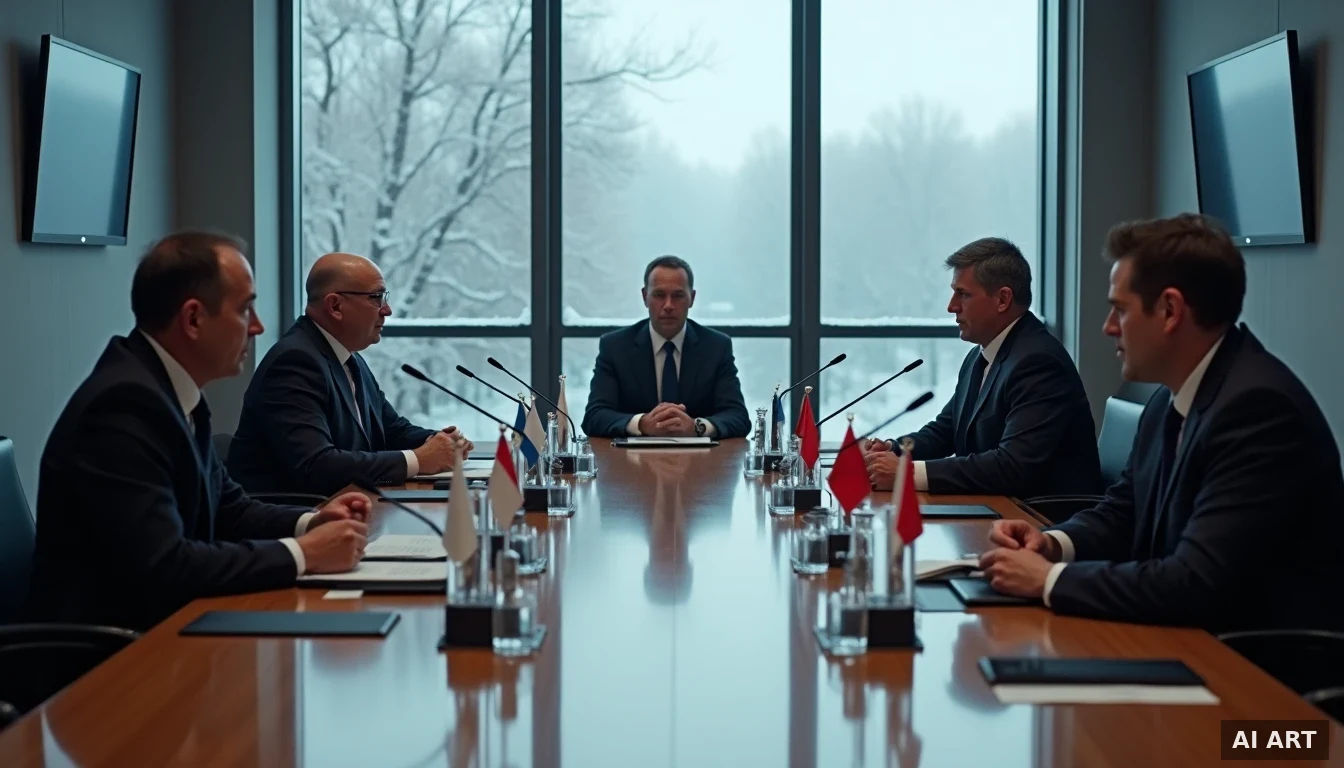
US-Iran War Ceasefire Holds as Europe Faces Renewed Energy Shock
Multi-perspective analysis. Each perspective deliberately argues one viewpoint; none represents the editorial position of qalarc.
Four months after US and Israeli airstrikes killed Iranian Supreme Leader Ali Khamenei and triggered the '2026 Iran war,' Washington and Tehran announced an interim agreement in June with a roadmap toward a final deal within 60 days. The war's ripple effects — chiefly Iran's closure of the Strait of Hormuz — have driven a documented European energy crisis, with gas storage at multi-year lows heading into winter. Online discussion has centered on whether Iran genuinely 'negotiated a deal,' on the depth of Europe's energy squeeze, and on sharply contested narratives about immigration and the causes of the conflict.
What the terms mean (5)
- Strait of Hormuz — A narrow waterway between Iran and Oman through which a large share of the world's seaborne oil and LNG passes; its closure sharply reduces global energy supply.
- E-3 — France, Germany and the United Kingdom, the three European powers that have jointly conducted nuclear diplomacy with Iran.
- TTF — Title Transfer Facility — the benchmark Dutch natural gas price index widely used as the reference for European wholesale gas.
- IAEA — The International Atomic Energy Agency, the UN nuclear watchdog responsible for inspecting and verifying nuclear programs.
- MOU — Memorandum of Understanding — a non-binding agreement outlining terms and intentions ahead of a formal deal.
The facts (8)
- On 28 February 2026, the US and Israel launched coordinated large-scale airstrikes on Iran, killing Supreme Leader Ali Khamenei and starting what is now referred to as the '2026 Iran war.' [1][3]
- Iran retaliated with missile and drone strikes on Israel, US bases and Gulf states, and closed the Strait of Hormuz, cutting roughly 20% of global LNG exports. [4][8]
- A US-Iran ceasefire took effect on 8 April 2026 — initially a two-week pause mediated by Pakistan — followed by a separate Israel-Lebanon ceasefire on 16 April 2026. [2]
- In June 2026 the US and Iran announced an interim agreement/MOU with a 'roadmap toward a final deal within 60 days'; technical talks were held in Switzerland on 21 June 2026. [5]
- IAEA chief Rafael Grossi said on 26 June 2026 that inspector access to Tehran's nuclear sites was part of the interim deal. [6]
- The party Iran negotiated with is the United States (mediated variously by Oman, Italy, Qatar and Pakistan), with parallel talks involving France, Germany and the UK (the E-3). [5][7]
- A European energy crisis is documented in 2026: TTF gas prices spiked and EU gas storage sat below 30-31% — the lowest since 2018 — heading into the 2026-27 winter. [8][10]
- France, the major economy with the highest nuclear dependency, flipped from net electricity exporter to importer during 2026 heatwaves, tied to nuclear cooling-water constraints. [11]
Context & background
US-Iran tensions escalated sharply across 2025-2026 before the February 2026 strikes, with negotiations mediated at various points by Oman, Italy, Qatar and Pakistan. The killing of Khamenei and the ensuing war marked one of the most significant Middle East escalations in decades, prompting Iran's closure of the Strait of Hormuz — a chokepoint through which a large share of global oil and LNG flows. [4] The Hormuz disruption compounded an already fragile European energy picture: with storage at its lowest since 2018 and record-low gas reserves, analysts describe Europe as facing a renewed energy shock heading into winter 2026-27. [8][9][10] France's shift from net electricity exporter to importer during summer heatwaves — driven by nuclear plant cooling-water limits rather than fossil-fuel export constraints — has become a focal example of the strain. [11] Online commentators have variously questioned the severity of the European energy narrative, debated immigration in the UK and Europe (some attributing negative narratives to Russian information operations), and framed the war's causes in sharply contested political terms; these framings are opinion and rhetoric rather than verifiable claims.
Still unresolved
- Whether the June 2026 interim US-Iran agreement will convert into a durable final deal within the stated 60-day window, and how far IAEA inspection access will extend.
- How long the Strait of Hormuz disruption and its LNG impact will persist, and whether Europe can rebuild gas storage before peak winter demand.
- Whether France's exporter-to-importer flip is a temporary heatwave effect or a longer-term structural constraint on its nuclear-heavy grid.
The same story, argued three ways. Pick an angle — the facts above stay the same.
🧭 Cui bono — who benefits?
Beneficiaries
- China — Geopolitical ascendancy as Western alliance fractures and US military credibility erodes
via US-Iran conflict (with reported 1,700+ civilian casualties and $300B liability) drains American resources and political capital while demonstrating limits of conventional military power; European energy crisis weakens transatlantic cohesion; Russian occupation tactics create humanitarian disasters that delegitimize Western-backed resistance narratives, allowing China to position itself as stable alternative pole - Iran — Regional hegemony and leverage over Western powers
via Reported conventional military success against US forces establishes deterrence credibility; US financial liability ($300B) creates negotiating leverage; ability to extract concessions (referenced missed deal opportunity suggests Iran holds strong bargaining position); Western distraction with European energy and Russian conflicts reduces pressure - Russian Federation — Strategic depth through territorial gains and weakened European opposition
via Forced conscription of occupied populations creates expendable manpower for continued expansion while depopulating resistance bases; European energy dependence (the 'major exporter facing winter difficulty' paradox suggests Europe remains structurally reliant on Russian energy despite rhetoric); disinformation campaigns (blamed for UK immigration narrative distortion) shape Western public opinion at minimal cost - Defense contractors and energy majors (multinational) — Sustained crisis premium pricing and long-term contract lock-in
via Escalating conflicts guarantee procurement cycles; European energy crisis enables above-market pricing regardless of actual supply constraints; reconstruction needs in Iran, Ukraine, and occupied territories create multi-decade revenue streams
Who loses
- European civilian populations (energy poverty, economic contraction)
- US taxpayers ($882 per capita liability to Iran, ongoing military costs)
- Iranian and Ukrainian civilians (infrastructure destruction, mass casualties)
- Military-age males in occupied territories (forced conscription as 'meatshields')
- Western liberal institutional credibility (failure to prevent atrocities or maintain alliance cohesion)
Rivalry & conflicts of interest
- United States harmed → China gains
conflict of interest: European states face choice between US security guarantees and Chinese/Russian economic ties; energy dependence creates structural incentive to accommodate Russia despite US pressure; some EU members hold significant Chinese infrastructure investment (Belt and Road) creating fiscal dependency - European Union harmed → Russian Federation gains
conflict of interest: Energy import contracts and pipeline infrastructure create sunk-cost lock-in; individual member states (Hungary, others) maintain separate relationships with Russia that undermine collective EU position; former officials often join Russian energy company boards - Ukraine and occupied populations harmed → Russian Federation gains
conflict of interest: Western aid fatigue benefits Russia as prolonged conflict becomes politically unsustainable for democracies; some Western politicians and parties receive Russian funding or media support; business interests in Russian markets create constituency for accommodation
Ramifications (follow the chain)
- US military credibility erosion -> allies pursue independent nuclear deterrence or accommodation with regional powers -> nonproliferation regime collapses -> arms race in Middle East and Asia -> heightened risk of nuclear exchange
- European energy crisis -> industrial base relocates to US/China -> deindustrialization -> permanent GDP reduction and welfare state unsustainability -> political radicalization -> EU fragmentation
- Russian forced conscription of occupied populations -> demographic erasure of resistance -> permanent territorial changes -> normalization of conquest -> other revisionist powers (China re: Taiwan) calculate that fait accompli works -> end of post-1945 territorial integrity norm
- Western failure to protect allies/enforce norms -> middle powers abandon alignment -> multipolar fragmentation -> loss of dollar/SWIFT leverage -> US unable to enforce sanctions -> sanctions become ineffective tool -> military force becomes only remaining lever -> more frequent wars
intentional reading China is strategically amplifying multiple simultaneous crises to accelerate US imperial overextension and European vassalization. The synchronization is suggestive: US bogged down in Iran (with financial and casualty costs that dwarf Afghanistan), Russia applying pressure to Europe through both energy leverage and military expansion, all while China remains conspicuously absent from direct confrontation. The prior research showing Europe/India unable to execute on AI despite resources, combined with Iran's reported military success, suggests coordinated technology/intelligence sharing within an anti-US bloc. The energy crisis paradox (major exporter struggling in winter) may indicate deliberate Russian supply manipulation coordinated with Chinese strategic petroleum reserve management to maximize European pain. The $300B US liability to Iran could represent a negotiated transfer facilitated by Chinese financial intermediation (Belt and Road lending patterns suggest China brokers such arrangements). The disinformation operations (Russian agitprop on UK immigration) serve to paralyze Western domestic politics while kinetic operations proceed. This reading suggests active great-power coordination to force multipolar transition through simultaneous crisis imposition.
structural reading No coordination required: the incentive structure produces convergent behavior. Russia exploits European energy dependence because it's the available lever and winter creates natural crisis point. Iran escalates because US is domestically exhausted after decades of Middle East engagement and current administration shows restraint. China simply waits because time favors the rising power while the hegemon manages multiple theaters. European energy crisis emerges from decade of underinvestment in domestic production (environmental policy) plus overreliance on single supplier (cost optimization). US financial liability to Iran follows from war damages under international law (automatic legal mechanism). Defense contractors and energy companies maximize profit within legal bounds during crisis (standard corporate behavior). Disinformation spreads because social media algorithms reward engagement and inflammatory content, not because of coordinated campaigns. Occupied populations get conscripted because that's what militaries do when manpower-limited. The outcome—US overextension, European weakness, Chinese ascendancy—emerges from independent rational actors following local incentives, not masterplan. Democracies underinvest in unglamorous resilience (energy, munitions production, civilian defense) because voters punish such spending until crisis hits, while autocracies maintain strategic reserves. The West loses because its political economy structurally disfavors long-term competitive positioning against patient rivals.
📊 Trading signals — winners & losers
Tradeable instruments most exposed to this story, inferred from the analysis above. Not financial advice — informational only, generated by AI from forum discussion and may be wrong.
📈 Likely winners
- ▲ CLcommodityCrude Oil$79.007d -7.0%✗ -7.0% since callGeopolitical crisis premium, energy supply disruption risk
- ▲ LMTstockLockheed Martin$578.637d +13.6%✓ +14.4% since callDefense contractor benefits from sustained military spending escalation
- ▲ RTXstockRaytheon Technologies$218.587d +12.4%✓ +12.9% since callLong-term defense contracts amid great power conflict
- ▲ XAUcommodityGold$4,0207d -1.3%✗ -1.2% since callSafe-haven demand during nuclear escalation and institutional collapse
- ▲ NGcommodityNatural Gas$2.687d -6.5%✗ -7.1% since callEuropean energy poverty drives crisis pricing premium
📉 Likely losers
- ▼ EZUETFiShares MSCI Europe ETF$67.867d +0.6%✓ -1.0% since callEuropean economic contraction and energy poverty scenario
- ▼ VGKETFVanguard FTSE Europe ETF$89.237d +1.8%✗ +0.5% since callWestern alliance fracture erodes European equity values
- ▼ DXcommodityU.S. Dollar Index$101.477d +0.3%✓ -0.0% since callUS military credibility erosion undermines reserve currency status
- ▼ BTCcryptoBitcoin$63,8737d -3.7%✓ -3.8% since callNuclear conflict risk drives flight to physical assets
📈 Call performance — day by day
| date | price | vs entry |
|---|---|---|
| 2026-07-21 | $84.91 | +0.0% |
| 2026-07-22 | $84.74 | -0.2% |
| 2026-07-23 | $87.80 | +3.4% |
| 2026-07-25 | $92.19 | +8.6% |
| 2026-07-26 | $89.31 | +5.2% |
| 2026-07-27 | $84.95 | +0.0% |
| 2026-07-28 | $81.41 | -4.1% |
| date | price | vs entry |
|---|---|---|
| 2026-07-21 | $505.94 | +0.0% |
| 2026-07-22 | $507.09 | +0.2% |
| 2026-07-23 | $514.36 | +1.7% |
| 2026-07-25 | $568.59 | +12.4% |
| 2026-07-26 | $582.60 | +15.2% |
| 2026-07-27 | $582.60 | +15.2% |
| 2026-07-28 | $580.00 | +14.6% |
| date | price | vs entry |
|---|---|---|
| 2026-07-21 | $193.67 | +0.0% |
| 2026-07-22 | $193.67 | +0.0% |
| 2026-07-23 | $194.88 | +0.6% |
| 2026-07-25 | $212.79 | +9.9% |
| 2026-07-26 | $212.79 | +9.9% |
| 2026-07-27 | $212.79 | +9.9% |
| 2026-07-28 | $218.42 | +12.8% |
| date | price | vs entry |
|---|---|---|
| 2026-07-21 | $4,070 | +0.0% |
| 2026-07-22 | $4,086 | +0.4% |
| 2026-07-23 | $4,119 | +1.2% |
| 2026-07-25 | $4,053 | -0.4% |
| 2026-07-26 | $4,071 | +0.0% |
| 2026-07-27 | $4,087 | +0.4% |
| 2026-07-28 | $4,075 | +0.1% |
| date | price | vs entry |
|---|---|---|
| 2026-07-21 | $2.88 | +0.0% |
| 2026-07-22 | $2.88 | +0.0% |
| 2026-07-23 | $2.94 | +1.9% |
| 2026-07-25 | $2.89 | +0.1% |
| 2026-07-26 | $2.89 | +0.1% |
| 2026-07-27 | $2.89 | +0.1% |
| 2026-07-28 | $2.76 | -4.4% |
| date | price | vs entry |
|---|---|---|
| 2026-07-21 | $68.54 | +0.0% |
| 2026-07-22 | $68.54 | +0.0% |
| 2026-07-23 | $68.82 | +0.4% |
| 2026-07-25 | $67.60 | -1.4% |
| 2026-07-26 | $67.93 | -0.9% |
| 2026-07-27 | $67.93 | -0.9% |
| 2026-07-28 | $68.26 | -0.4% |
| date | price | vs entry |
|---|---|---|
| 2026-07-21 | $88.76 | +0.0% |
| 2026-07-22 | $88.76 | +0.0% |
| 2026-07-23 | $89.09 | +0.4% |
| 2026-07-25 | $88.41 | -0.4% |
| 2026-07-26 | $88.41 | -0.4% |
| 2026-07-27 | $88.41 | -0.4% |
| 2026-07-28 | $88.84 | +0.1% |
| date | price | vs entry |
|---|---|---|
| 2026-07-21 | $101.51 | +0.0% |
| 2026-07-27 | $101.51 | +0.0% |
| 2026-07-28 | $101.51 | +0.0% |
| date | price | vs entry |
|---|---|---|
| 2026-07-21 | $66,408 | +0.0% |
| 2026-07-22 | $66,315 | -0.1% |
| 2026-07-23 | $65,757 | -1.0% |
| 2026-07-25 | $63,792 | -3.9% |
| 2026-07-26 | $64,412 | -3.0% |
| 2026-07-27 | $65,073 | -2.0% |
| 2026-07-28 | $63,175 | -4.9% |
📊 See how every call has performed — the full scoreboard & API →
From the threads
The posts that drew the most replies in the source discussion — shown as posted. Reactions ranged across the spectrum; these are the ones people actually engaged with. Each quote links to its archived source thread so you can verify it; quotes we couldn't tie to a source thread are marked source unverified.
Continue the discussion
Add your own take — replies are kept on this article and can be upvoted.
🔗 Related Analysis
- Iran military victory and global power realignment shared: china, iran, usa
- Why non-US/China regions fail to develop frontier AI models shared: china, europe, russia, usa
- Russian use of Donbas civilians as forcibly mobilized fighters against Ukraine shared: china, russia, usa
- Iran war civilian casualty toll and infrastructure damage shared: iran, usa
- Speculation about end of Russian military presence shared: europe, russia
- Satirical post impersonating Iranian demanding US money shared: iran, usa
References
- [1] ◎ 2026 Iran war — Britannica
- [2] ◎ 2026 Iran war ceasefire — Wikipedia
- [3] ◎ UK House of Commons Library research briefing CBP-10637
- [4] ◑ Iran's War With Israel and the United States — CFR Global Conflict Tracker
- [5] ◖ June 21, 2026 — Negotiations with Iran after Trump's threat disrupts talks — CNN
- [6] ◎ U.S.-Iran deal grants access to Tehran's nuclear sites: UN watchdog — CNBC
- [7] ◎ Congressional Research Service — IF13247
- [8] ACER Gas Key Developments — Winter 2026
- [9] Europe is sleepwalking into a self-inflicted energy crisis — EU Perspectives
- [10] A more resilient Europe faces a renewed energy shock — CEPR
- [11] Europe Heatwave Energy Crisis: Grid Failures & Costs — Discovery Alert
- [12] ◎ France electricity net importer 2026 heatwave nuclear constraints — Reuters
◖ supportive · ◗ critical · ◎ neutral wire · ◑ partisan · ⚑ state outlet
▾ Discussion
Select any text in the article to comment on that passage.