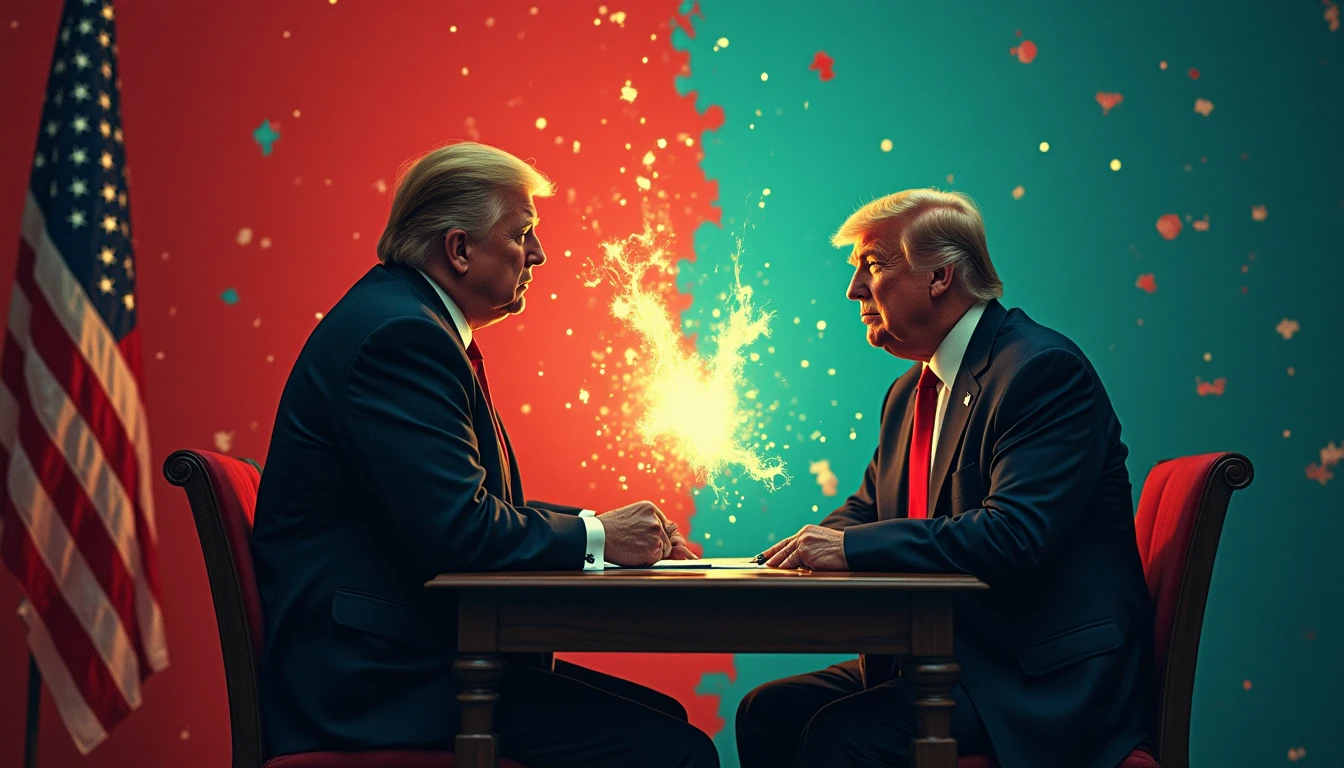
US Releases 14-Point Text of Iran 'Islamabad Memorandum'; Ceasefire Tested by Strait of Hormuz Clash
Multi-perspective analysis. Each perspective deliberately argues one viewpoint; none represents the editorial position of qalarc.
On June 17, 2026, the United States publicly released the official 14-point text of a Memorandum of Understanding with Iran—dubbed the 'Islamabad Memorandum'—signed that day by President Donald Trump and Iranian President Masoud Pezeshkian to end the 2026 Iran war. Senior US officials read the document to reporters after criticism that the text had not been disclosed, and Pezeshkian published it on June 18, calling it 'a historic document.' The framework declares a permanent end to military operations, opens a 60-day window for a final deal, reopens the Strait of Hormuz, and proposes a $300 billion reconstruction plan for Iran.
What the terms mean (5)
- Islamabad Memorandum — The name given to the brief US-Iran Memorandum of Understanding signed June 17, 2026, ending active fighting in the 2026 war; reporting credits Pakistan as the primary broker.
- Memorandum of Understanding (MoU) — A preliminary, often non-binding 'political document' setting out a framework and intentions, distinct from a final, detailed treaty or peace deal.
- Strait of Hormuz — A narrow, strategically critical waterway between Iran and the Arabian Peninsula through which a large share of the world's seaborne oil passes.
- IRGC — Iran's Islamic Revolutionary Guard Corps, a branch of the country's armed forces; reporting attributes the June 25/26 drone strike on the cargo ship to it.
- Ever Lovely — The Singapore-flagged cargo ship reported struck by an Iranian drone in the Strait of Hormuz on June 25/26, 2026, prompting US retaliatory strikes.
The facts (8)
- Senior US officials read the 14-point MoU text to reporters on a call on June 17, 2026; Iran's president published the document on X on June 18, calling it 'a historic document.' [2][3][4]
- Trump signed the memorandum during a dinner at the Palace of Versailles following the G7 summit, while Pezeshkian signed in Tehran; reporting describes the agreement as brokered primarily by Pakistan. [1][12]
- The MoU declares an immediate and permanent end to military operations on all fronts including Lebanon, sets a 60-day window to negotiate a final deal, reopens the Strait of Hormuz, and waives/lifts sanctions. [2][5]
- The agreement calls for the US, with regional partners, to develop a reconstruction and economic-development plan worth at least $300 billion for Iran, with the implementation mechanism to be finalized within 60 days. [5][6]
- Trump has explicitly denied that the US government is paying $300 billion to Iran, calling the characterization 'fake news' and saying American taxpayers would not fund it; reporting describes the $300B as a proposed, not-yet-funded reconstruction plan. [6]
- The US Treasury waived sanctions on Iran for 60 days on June 21, 2026, and US Central Command ended its naval blockade on June 18. [5][7]
- On June 26, 2026, the US carried out retaliatory airstrikes on Iranian missile/drone storage and coastal radar sites after Trump accused Iran of a 'foolish violation' of the ceasefire, following an IRGC drone strike on the Singapore-flagged cargo ship Ever Lovely in the Strait of Hormuz on June 25/26. [8][9][10]
- Analysts describe the MoU as a brief preliminary 'political document' rather than a final peace deal, deferring the nuclear program, uranium stockpiles, ballistic missiles, and most sanctions details to future negotiations. [7][5]
Context & background
The underlying war was launched by the United States and Israel against Iran on February 28, 2026; an earlier ceasefire was reached around April 7-8, 2026, before the framework agreement of June 2026. [1][11] The Islamabad Memorandum followed months of intermittent US-Iran negotiations dating to 2025. [11] Online commentators have characterized the outcome as a US defeat that left Washington 'subordinate to Iran' and as a war that 'transferred $300 billion' to Tehran—framings that go beyond what mainstream reporting establishes, since the reconstruction fund remains unfunded and the war's outcome is described as a negotiated framework with concessions on both sides, not a documented surrender. [6][7] As of June 26-27, 2026, each side accused the other of violating the deal: Iran says it controls passage through the strait under the MoU, while Israel has continued strikes in Lebanon. The MoU framework remains formally in place with talks ongoing, though the ceasefire is visibly fragile. [8][9]
Still unresolved
- Who will actually fund the $300 billion reconstruction plan, and through what mechanism, once the 60-day implementation window closes?
- Will the ceasefire hold after the June 25-26 drone strike and US retaliation, and how are competing US and Iranian interpretations of Strait of Hormuz passage rights resolved?
- How will the deferred core issues—Iran's nuclear stockpile, ballistic missiles, and the bulk of sanctions—be addressed in any final agreement?
The same story, argued three ways. Pick an angle — the facts above stay the same.
🧭 Cui bono — who benefits?
Beneficiaries
- Iran — Strategic legitimization, $300 billion in reported payments, and reversal of military/diplomatic isolation
via If claims are accurate, Iran extracts massive financial transfer while cementing a negotiated settlement that implicitly recognizes its regional position—transforming from pariah state to deal-making peer. The public MoU release itself signals normalization. - China and Russia — Weakened US deterrence posture and reduced credibility with Middle East allies
via A widely-perceived US military failure followed by large payments to an adversary undermines American security guarantees to Gulf states and Israel, pushing them toward hedging strategies that include Beijing and Moscow. Erodes the petrodollar enforcement apparatus. - US defense contractors (secondary/perverse) — Justification for next-generation procurement cycles despite operational failure
via Even a 'lost' $80 billion expenditure flows to Lockheed, Raytheon, Northrop—and the narrative of inadequate systems creates demand for upgraded platforms. Failure rarely cuts budgets; it often expands them under the banner of 'we need better tools next time.' - Domestic Trump opponents — Political ammunition for 2024 and beyond
via If the deal is framed as capitulation after expensive failure, it becomes a wedge issue. Obama's prior Iran deal experience positions him and aligned Democrats as comparatively competent stewards of Middle East policy.
Who loses
- US taxpayers ($380 billion total: $80B spent + $300B transferred)
- Saudi Arabia and UAE (their primary adversary strengthened and bankrolled)
- Israel (Iranian strategic position dramatically improved)
- US global military credibility and deterrence theory
Rivalry & conflicts of interest
- US geopolitical dominance in Middle East harmed → Iran, China, Russia gains
conflict of interest: No direct financial COI known, but structural: any outcome that forces Gulf states to diversify away from USD reserves benefits Chinese yuan internationalization and Russian energy leverage. - Trump administration legacy/credibility harmed → Democratic Party establishment, Obama foreign policy alumni gains
conflict of interest: Speculative intelligence leverage (Epstein files claim): if compromising material exists, releasing MoU details during a politically sensitive window maximizes damage and creates pressure for the specific terms reported. - Israeli and Saudi security position harmed → Iran and its proxies (Hezbollah, Houthis, Iraqi militias) gains
conflict of interest: None in US decision-making apparatus, but creates dependency: weakened Sunni allies may demand increased US support elsewhere, paradoxically locking in long-term defense commitments even after this 'withdrawal.'
Ramifications (follow the chain)
- Gulf states accelerate nuclear hedging programs (Saudi Arabia, UAE pursue domestic enrichment) → proliferation cascade → Israel recalculates pre-emptive strike threshold → regional arms race regardless of MoU terms.
- $300B Iranian windfall → sanctions evasion infrastructure becomes obsolete → European firms rush back in → US secondary sanctions lose teeth → dollar's role as sanctions enforcement mechanism degrades → reserve currency diversification accelerates.
- Perception of US inability to win regional wars → Taiwan recalculates US commitment credibility → Beijing's 2027-2030 reunification window looks more attractive → semiconductor sanctions become more urgent as geopolitical hedge → tech decoupling accelerates regardless of trade policy.
- Defense budget critique gains traction ('$80B for a loss') → but contractors pivot to AI/autonomous systems narrative ('human failures, not hardware') → next budget cycle emphasizes unmanned platforms → labor-intensive military employment drops → another Rust Belt economic shock → populist cycle reinforces.
intentional reading If the Epstein intelligence file claims have any basis, this represents a sophisticated leverage play: compromise material on Trump related to Iran creates a forcing function for a deal on humiliating terms, released publicly to maximize political damage during a election cycle. The $300B figure is almost designed to enrage—large enough to dominate headlines, framed as 'reparations' to activate maximum nationalist backlash against the dealmaker. The beneficiary would be whoever holds the leverage (speculated intelligence services, either domestic opponents or Iranian/intermediary actors) and wants Trump both weakened AND committed to a deal he can't escape. The timing of the public MoU release—making retreat impossible—fits a 'lock him in, then burn him' strategy.
structural reading No blackmail necessary: Trump's transactional 'art of the deal' philosophy encounters an adversary (Iran) that survived maximum pressure, has Chinese/Russian backing, and held escalation dominance through proxy networks. The $80B expenditure produced no decision-forcing outcome; Iran's cost tolerance (via proxies) exceeded US political tolerance for casualties. A negotiated exit becomes inevitable, and Iran extracts maximum payment because it can—the alternative is indefinite bleeding. The MoU release is standard diplomatic practice (transparency after conclusion), but in the US political environment it becomes a weapon opponents wield automatically. Defense contractors benefit regardless because the system is designed to reward spending, not victory. China and Russia gain structurally because any US overextension in the Middle East reduces focus on their theaters. No conspiracy required—just aligned incentives meeting expensive reality.
📊 Trading signals — winners & losers
Tradeable instruments most exposed to this story, inferred from the analysis above. Not financial advice — informational only, generated by AI from forum discussion and may be wrong.
📈 Likely winners
- ▲ CLcommodityCrude Oil$84.677d -5.2%✓ +14.1% since callIranian oil export capacity unlocked, supply increase pressures prices
- ▲ LMTstockLockheed Martin$582.747d +2.5%✓ +15.2% since callMiddle East allies seek rearmament after US credibility loss
- ▲ RTXstockRaytheon Technologies$215.227d +2.9%✓ +9.4% since callSaudi/UAE defensive procurement rises against emboldened Iran
📉 Likely losers
- ▼ XAUcommodityGold$4,1077d +1.0%✗ +0.9% since callReduced Middle East conflict premium with diplomatic resolution
- ▼ DXYcommodityUS Dollar Index$99.807d -1.6%✓ -1.2% since callUS credibility erosion weakens reserve currency confidence premium
- ▼ ISRAETFIsrael bonds ETF$64.067d +0.4%✓ -0.7% since callIranian strategic position improved threatens Israeli security premium
📈 Call performance — day by day
| date | price | vs entry |
|---|---|---|
| 2026-06-28 | $74.20 | +0.0% |
| 2026-07-21 | $83.71 | +12.8% |
| 2026-07-22 | $84.74 | +14.2% |
| 2026-07-23 | $87.80 | +18.3% |
| 2026-07-25 | $92.19 | +24.2% |
| 2026-07-26 | $89.31 | +20.4% |
| 2026-07-27 | $84.95 | +14.5% |
| 2026-07-28 | $81.41 | +9.7% |
| 2026-07-29 | $82.23 | +10.8% |
| 2026-07-30 | $83.50 | +12.5% |
| 2026-07-31 | $84.09 | +13.3% |
| 2026-08-01 | $86.80 | +17.0% |
| 2026-08-02 | $84.67 | +14.1% |
| date | price | vs entry |
|---|---|---|
| 2026-06-28 | $505.99 | +0.0% |
| 2026-07-21 | $505.99 | +0.0% |
| 2026-07-22 | $507.09 | +0.2% |
| 2026-07-23 | $514.36 | +1.7% |
| 2026-07-25 | $568.59 | +12.4% |
| 2026-07-26 | $582.60 | +15.1% |
| 2026-07-27 | $582.60 | +15.1% |
| 2026-07-28 | $580.00 | +14.6% |
| 2026-07-29 | $581.31 | +14.9% |
| 2026-07-30 | $569.20 | +12.5% |
| 2026-07-31 | $574.11 | +13.5% |
| 2026-08-01 | $582.74 | +15.2% |
| 2026-08-02 | $582.74 | +15.2% |
| date | price | vs entry |
|---|---|---|
| 2026-06-28 | $196.78 | +0.0% |
| 2026-07-21 | $196.78 | +0.0% |
| 2026-07-22 | $193.67 | -1.6% |
| 2026-07-23 | $194.88 | -1.0% |
| 2026-07-25 | $212.79 | +8.1% |
| 2026-07-26 | $212.79 | +8.1% |
| 2026-07-27 | $212.79 | +8.1% |
| 2026-07-28 | $218.42 | +11.0% |
| 2026-07-29 | $218.58 | +11.1% |
| 2026-07-30 | $215.25 | +9.4% |
| 2026-07-31 | $214.38 | +8.9% |
| 2026-08-01 | $215.22 | +9.4% |
| 2026-08-02 | $215.22 | +9.4% |
| date | price | vs entry |
|---|---|---|
| 2026-06-28 | $4,070 | +0.0% |
| 2026-07-21 | $4,070 | +0.0% |
| 2026-07-22 | $4,086 | +0.4% |
| 2026-07-23 | $4,119 | +1.2% |
| 2026-07-25 | $4,053 | -0.4% |
| 2026-07-26 | $4,071 | +0.0% |
| 2026-07-27 | $4,087 | +0.4% |
| 2026-07-28 | $4,075 | +0.1% |
| 2026-07-29 | $4,017 | -1.3% |
| 2026-07-30 | $4,135 | +1.6% |
| 2026-07-31 | $4,173 | +2.6% |
| 2026-08-01 | $4,099 | +0.7% |
| 2026-08-02 | $4,107 | +0.9% |
| date | price | vs entry |
|---|---|---|
| 2026-06-28 | $100.97 | +0.0% |
| 2026-07-21 | $100.97 | +0.0% |
| 2026-07-22 | $101.19 | +0.2% |
| 2026-07-23 | $101.05 | +0.1% |
| 2026-07-25 | $101.44 | +0.5% |
| 2026-07-26 | $101.47 | +0.5% |
| 2026-07-27 | $101.32 | +0.3% |
| 2026-07-28 | $101.51 | +0.5% |
| 2026-07-29 | $101.39 | +0.4% |
| 2026-07-30 | $100.91 | -0.1% |
| 2026-07-31 | $99.97 | -1.0% |
| 2026-08-01 | $99.80 | -1.2% |
| 2026-08-02 | $99.80 | -1.2% |
| date | price | vs entry |
|---|---|---|
| 2026-06-28 | $64.48 | +0.0% |
| 2026-07-21 | $64.48 | +0.0% |
| 2026-07-22 | $64.97 | +0.8% |
| 2026-07-23 | $64.35 | -0.2% |
| 2026-07-25 | $63.78 | -1.1% |
| 2026-07-26 | $64.07 | -0.6% |
| 2026-07-27 | $64.07 | -0.6% |
| 2026-07-28 | $63.90 | -0.9% |
| 2026-07-29 | $63.60 | -1.4% |
| 2026-07-30 | $61.96 | -3.9% |
| 2026-07-31 | $63.59 | -1.4% |
| 2026-08-01 | $64.06 | -0.7% |
| 2026-08-02 | $64.06 | -0.7% |
📊 See how every call has performed — the full scoreboard & API →
🔗 Related Analysis
- Iran military gains assertion shared: iran, trump
- Criticism of perceived ignorance about Iran among a demographic group shared: iran, trump
- Iran's recent military campaign characterized as catastrophic failure shared: iran, us
- Trump administration criticized for Iran war and $300 billion settlement shared: iran, trump
- Epstein allegedly held compromising files on Trump regarding Iran shared: iran, trump
- Obama's Iran deal credibility debate shared: iran, trump
References
- [1] ◎ Islamabad Memorandum - Wikipedia
- [2] ◖ US releases official agreement with Iran. Read the 14-point text | CNN
- [3] ◖ Text of the Iran-U.S. memorandum of understanding — NBC News
- [4] ◖ Read the 14 points of the agreement between Iran and the U.S. - CBS News
- [5] ◎ Trump's U.S.-Iran framework agreement, explained — NPR
- [6] ◎ Who's expected to fund Trump's $300 billion Iran plan? — NPR
- [7] ◑ The Iran Deal Reopens the Strait. Much Remains to Be Done. — CFR
- [8] ◎ Trump, Iran ceasefire, Strait of Hormuz — CNBC
- [9] ◎ US strikes Iran in response to drone strike on commercial ship — Al Jazeera
- [10] ◎ U.S. strikes Iran in response to drone attack on cargo ship — PBS News
- [11] ◎ 2025–2026 Iran–United States negotiations - Wikipedia
- [12] ◎ Full text of Trump's framework agreement to end Iran war — NPR
◖ supportive · ◗ critical · ◎ neutral wire · ◑ partisan · ⚑ state outlet
▾ Discussion
Select any text in the article to comment on that passage.